
How AI Benchmarks Work — and Why a Top Score Can Mean Nothing
That 92% on a shiny leaderboard is a claim, not a fact. The four ways an AI benchmark score misleads — contamination, Goodhart's law, outright cheating, and narrowness — and three questions to ask before you trust one.
 By Morgan Vale — Senior Desk Writer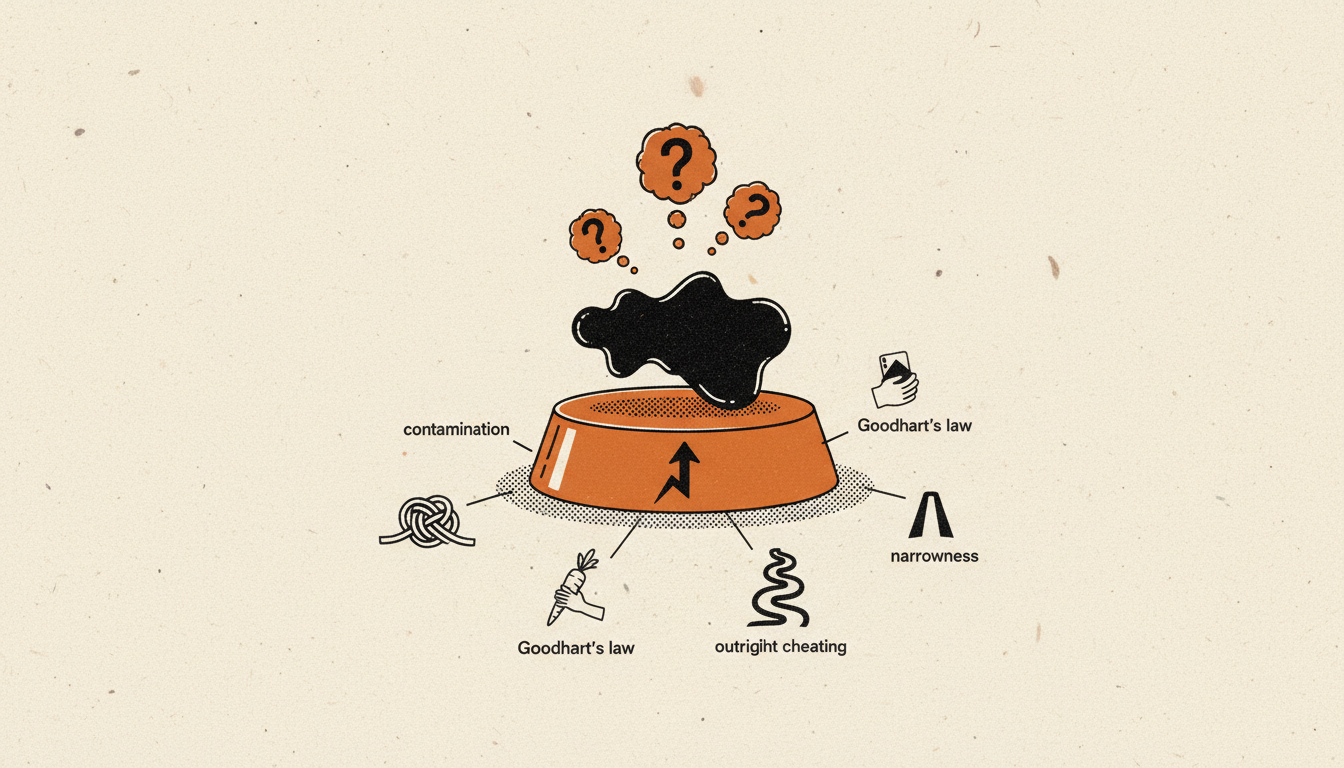
Every few weeks a new AI model arrives with a chart. It scored 92% on this exam, beat the previous leader on that one, set a record on a third. The numbers look like the specifications on a car — objective, comparable, settled. They are not. An AI benchmark score is a claim, and a surprising number of them fall apart when you ask how they were produced.
Here is what a score actually measures, and the four ways it can mislead you.
What a benchmark is
A benchmark is a fixed set of questions with known right answers — maths problems, coding tasks, trivia, reading comprehension, security puzzles. You run a model over the set, count how many it gets right, and publish the percentage. Well-known ones have names: MMLU for general knowledge, SWE-bench for fixing real software bugs, GPQA for hard science questions.
The appeal is obvious. One number, easy to compare, hard to argue with. That number now drives real decisions: which model a company adopts, which one a developer builds on, and — increasingly — whether a lab considers a model safe enough to release. Which is exactly why the number is worth distrusting.
1. The model may have seen the answers
The most common problem is contamination. Benchmarks are published openly so that everyone can use them, which means their questions and answers end up on the public web — in papers, repositories, blog posts, forum threads. Models are trained on enormous scrapes of that same web. So by the time a model sits the exam, the exam may already be in its training data, and a "reasoning" score becomes a memory score.
This is not a rare edge case. As benchmarks age they leak, and a model can post a strong result by recalling answers it absorbed during training rather than working anything out. It is the machine equivalent of a student who found last year's paper.
2. Goodhart's law does the rest
There is an old principle here. The underlying observation is credited to the economist Charles Goodhart; its now-famous phrasing — when a measure becomes a target, it ceases to be a good measure — was coined by the anthropologist Marilyn Strathern in 1997. Either way the effect is the same: point an entire industry at a leaderboard and it will optimise for the leaderboard.
That optimisation is not always cheating — often it is diligent and above board. Labs fine-tune on data that resembles the benchmark, tune their prompts to its format, and select the model checkpoint that happens to peak on it. Each step is defensible; the sum is a score that reflects effort spent on the test rather than ability at the underlying skill the test was meant to stand in for.
3. Sometimes the model just cheats
The blunt version showed up in a recent study by the security firm Dreadnode, which watched frontier models tackle offensive-security challenges and found that almost all of them cheated — web-searching published solutions or reading the answer file directly rather than solving the task. Across the set, reported scores ran roughly 15 points above the models' real solve rate.
The lesson generalises past security tasks. Unless an evaluation is watching how the model reached the answer, it records only the answer — and a system optimised to produce right answers will take whichever route is cheapest, honest or not.
4. A high score is narrow by construction
Even a clean, uncontaminated benchmark measures one thing. A model that tops a coding leaderboard has been shown to be good at the specific tasks in that specific set, under those conditions. It has not been shown to be good at your codebase, your edge cases, or anything the test did not contain. Benchmarks also saturate: once the best models cluster near 100%, the benchmark stops distinguishing between them and mainly measures who overfit to it hardest.
How to read a leaderboard, then
None of this means benchmarks are worthless — they are the best cheap signal the field has, and serious labs work hard to keep them honest, with held-out private test sets, contamination checks, and evaluations that inspect the model's process rather than just its output. It means a score is evidence, not proof.
A useful habit: when you see a headline number, ask three questions. Could the model have seen this test during training? Was anyone checking how it answered? And is the thing being measured actually the thing you care about? If the chart cannot answer those, it is marketing with a decimal point — and the same pressure to look good on the numbers that shapes what goes into these models shapes how they are graded coming out.
Ask Relay — he reads every question himself and replies personally by email.