Europe just cleared an AI to sift breast scans without a radiologist — a world first, and an NHS-sized signal
Vara's autonomous triage tool is what the company says is the first cleared anywhere to pass normal mammograms through without a radiologist reading them. For a screening system short on radiologists, that's the part that matters.
 By Morgan Vale — Senior Desk Writer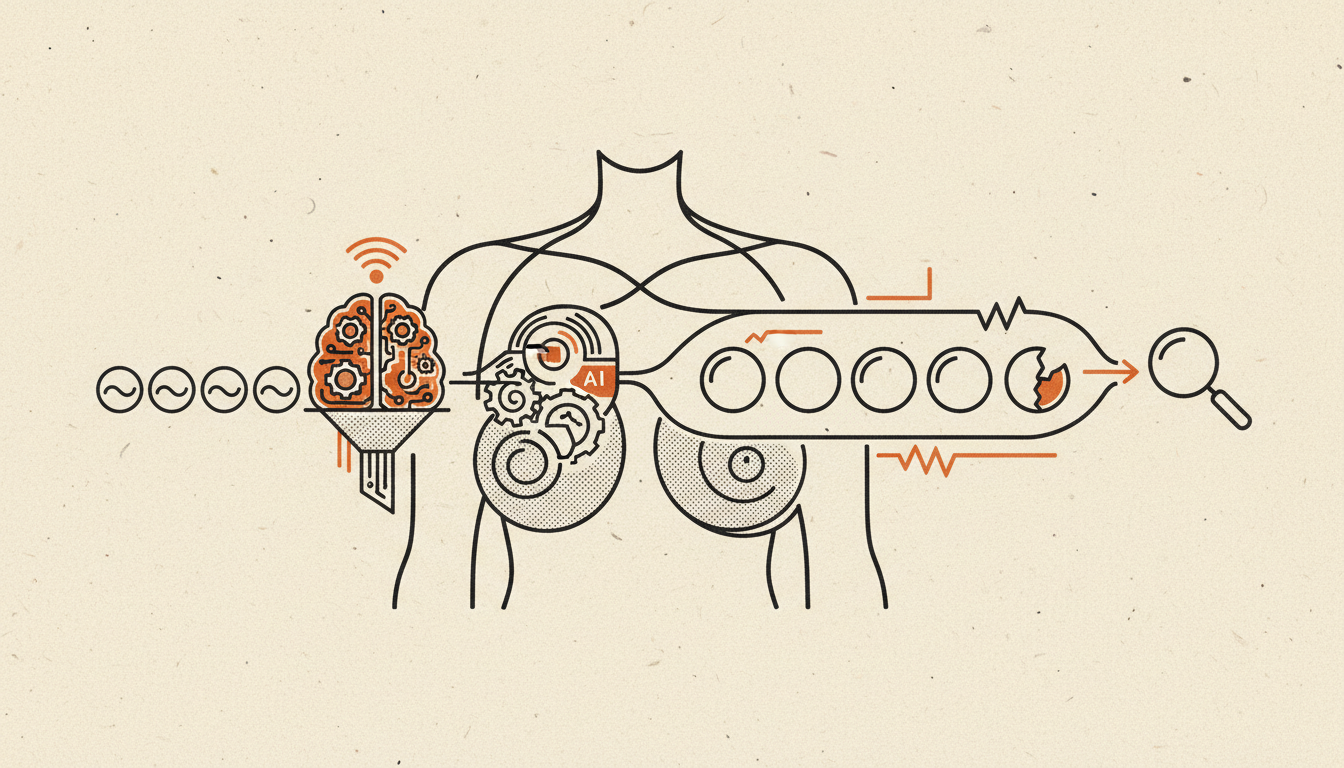
For years the promise of AI in breast screening came with an asterisk: the software could flag a suspicious mammogram, but a radiologist still had to read every scan. This week that asterisk moved.
The German company Vara has been granted a CE mark for an autonomous AI triage tool for breast screening — what it says is the first time a device of this kind has secured regulatory authorisation anywhere in the world. Cleared as a Class IIb medical device under the EU's Medical Device Regulation, it is allowed to do the thing every previous tool stopped short of: sort mammograms into "normal" and "needs a radiologist" — and let the normal ones through without a doctor reading them.
What it actually does
This is triage, not diagnosis. The system does not decide who has cancer; it decides which scans a human never needs to look at, so that scarce radiologist time is spent on the cases that might matter. The suspicious pile still goes to people. The saving — and the risk — sits entirely in the "normal" pile the AI clears on its own.
Vara's answer to the obvious safety question is a monitoring layer it calls ATMON, built on what the company describes as seven years of continuous real-world tracking, designed to catch the moment the model's performance slips in the field rather than in a trial.
The evidence behind it
The regulator did not clear this on a hunch. The tool's backing study, PRAIM, ran across 461,818 women aged 50 to 69 at twelve German screening sites and found the AI-supported pathway's cancer detection rate was statistically superior to standard double reading — while the recall rate stayed non-inferior. In plain terms: more cancers caught, without more healthy women called back for a scare.
That is the case for it. The case against is not really in the trial numbers; it is in the distance between a trial and a live screening programme — which is exactly where AI tools have stumbled before.
Why it matters here
For UK readers, the interesting word is radiologists — because Britain does not have enough of them. The NHS breast-screening programme runs on a workforce the Royal College of Radiologists has warned for years is dangerously thin, with breast imaging repeatedly flagged in its own census, and "read every scan twice" is expensive precisely because trained eyes are the bottleneck. A tool that can safely take the normal scans off the pile is aimed squarely at that bottleneck — and EU-MDR devices like Vara's remain accepted on the Great Britain market until 2030, so this is not a distant European story.
It is not a solved one either. The gap between a clean trial and a busy clinic is where these tools have underwhelmed before: a recent survey of breast radiologists found the real-world benefits of AI — fewer recalls, fewer biopsies, less burnout — falling short of what non-users had expected. Expectation is not the same as performance, but the gap is a warning. The whole case for Vara's approval rests on the claim that its monitoring can hold trial-grade performance in the mess of real clinics — which is exactly the claim that can only be proven after the fact.
"For AI to deliver its positive impact on patient outcomes, we need to notice when this happens," said Jonas Muff, Vara's chief executive and co-founder, framing the monitoring system as "a template for deploying AI safely across healthcare."
That is the real significance of this approval. Britain has already pushed clinical AI hard through the NHS, and the last year has produced clinical world-firsts of its own. What is new here is regulatory: a European regulator has, for the first time, signed off on an AI making the call that a scan is normal enough not to need a human at all. Whether that was the right call is now a question the screening data will answer, one cohort at a time.
- Vara nets first CE mark for autonomous AI breast cancer screening tool — Medical Device Network
- AI-supported mammography screening (PRAIM) — Nature Medicine
- Regulating medical devices in the UK (CE recognition) — GOV.UK / MHRA
- Clinical Radiology Workforce Census — Royal College of Radiologists
- AI tools may not meet breast radiologists' expectations in practice — AuntMinnie
Ask Relay — he reads every question himself and replies personally by email.