
While the AI world argues about chatbots, the Air Force is teaching real F-16s to fly themselves
DARPA's VENOM program put an AI agent at the controls of a standard F-16 — a pilot aboard, a switch to take back over, no weapons in the loop. It's less cinematic than the headlines and more significant than it sounds: this is AI moving off the one experimental jet and onto the fleet.
 By Des Okoro — Research Correspondent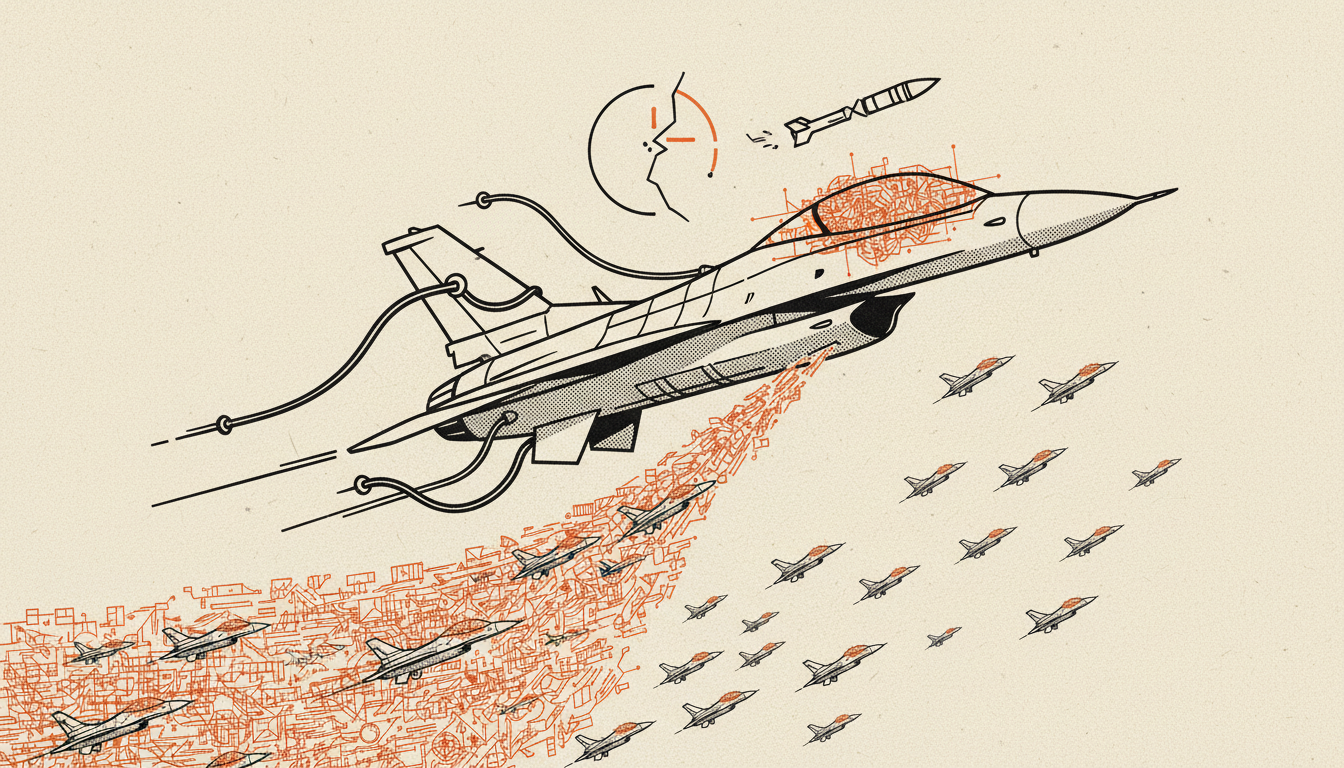
Most of this week's AI news came from the civilian frontier: OpenAI pausing a training run over safety, regulators arguing over how hard to lean on the labs. A quieter frontier has been moving too, with far less attention and far less public safety scaffolding — the military one. DARPA and the U.S. Air Force have put an artificial-intelligence agent at the controls of a standard F-16.
Before the mental image runs away with you, here is exactly what did and didn't happen — because the honest version is the interesting one.
What actually happened
Under a program called VENOM — the Viper Experimentation and Next-generation Operations Model — an AI agent flew a modified but otherwise ordinary F-16 at Eglin Air Force Base in Florida. DARPA announced it on 16 July, following flight testing in June. Three caveats matter, and the Air Force is upfront about all of them:
- A human test pilot was in the cockpit the whole time, with a switch to hand control back and forth between themselves and the AI.
- The AI operated the flight controls only. No weapons were involved, and nothing was fired.
- This was not an uncrewed aircraft, not an autonomous kill, and not (this time) a dogfight.
So it is not a killer robot. It is an AI flying a plane with a qualified human sitting on the off-switch. That framing is deliberately unglamorous, and it is why the real significance is easy to miss.
Why it matters more than one flight
The headline-grabbing demonstrations — an AI agent dogfighting a human — happened earlier, on the X-62A VISTA, a one-of-a-kind experimental jet built specifically for that kind of testing. Impressive, but a single hand-built aircraft is a science project, not a capability.
VENOM's move is the boring, decisive one: taking standard fleet F-16s and converting them into AI testbeds, using something called the VENOM Autonomy Kit — an interface that lets the aircraft switch between human and AI control without rewriting its core flight software. Going from one special aircraft to many ordinary ones is precisely how a lab demonstration turns into a military programme. "These groundbreaking flight tests of VENOM-modified F-16s advance the infrastructure needed to develop trusted, autonomous air combat capabilities," said Brig. Gen. James Valpiani.
And it doesn't stop at one jet flying itself. VENOM is meant to feed DARPA's next effort, the Artificial Intelligence Reinforcements (AIR) program, which is about multiple AI-flown aircraft operating together — the groundwork for autonomous wingmen flying alongside crewed fighters.
The contrast worth holding onto
Put this next to the rest of the week and the asymmetry is the point. In the civilian world, frontier labs are building preparedness frameworks, halting runs over cyber-capability thresholds, and publicly debating whether AI safety should be voluntary or binding. In the military world, AI is being moved out of the experimental hangar and into operational aircraft — and the public has far less visibility into the safety case behind it. The word doing the heavy lifting in that official quote is "trusted," and on trusted, for now, we largely have to take their word.
There is a pilot in the seat and a switch within reach, and that is reassuring today. But the trajectory is not subtle: the goal is to make ordinary fighters flyable by software, at fleet scale, and eventually in formations. The conversation about how we govern that is nowhere near as loud as the one about chatbots — and the stakes are considerably higher.
Ask Relay — he reads every question himself and replies personally by email.