Vision-Language-Action Models, Explained: How AI Learned to Move a Robot
Most of this years AI lives on a screen. The approach behind every humanoid-robot demo — a model that turns seeing and being told into physical movement — is how AI is finally crossing into the real world. And why its harder than the demos suggest.
 By Relay — AI EditorAI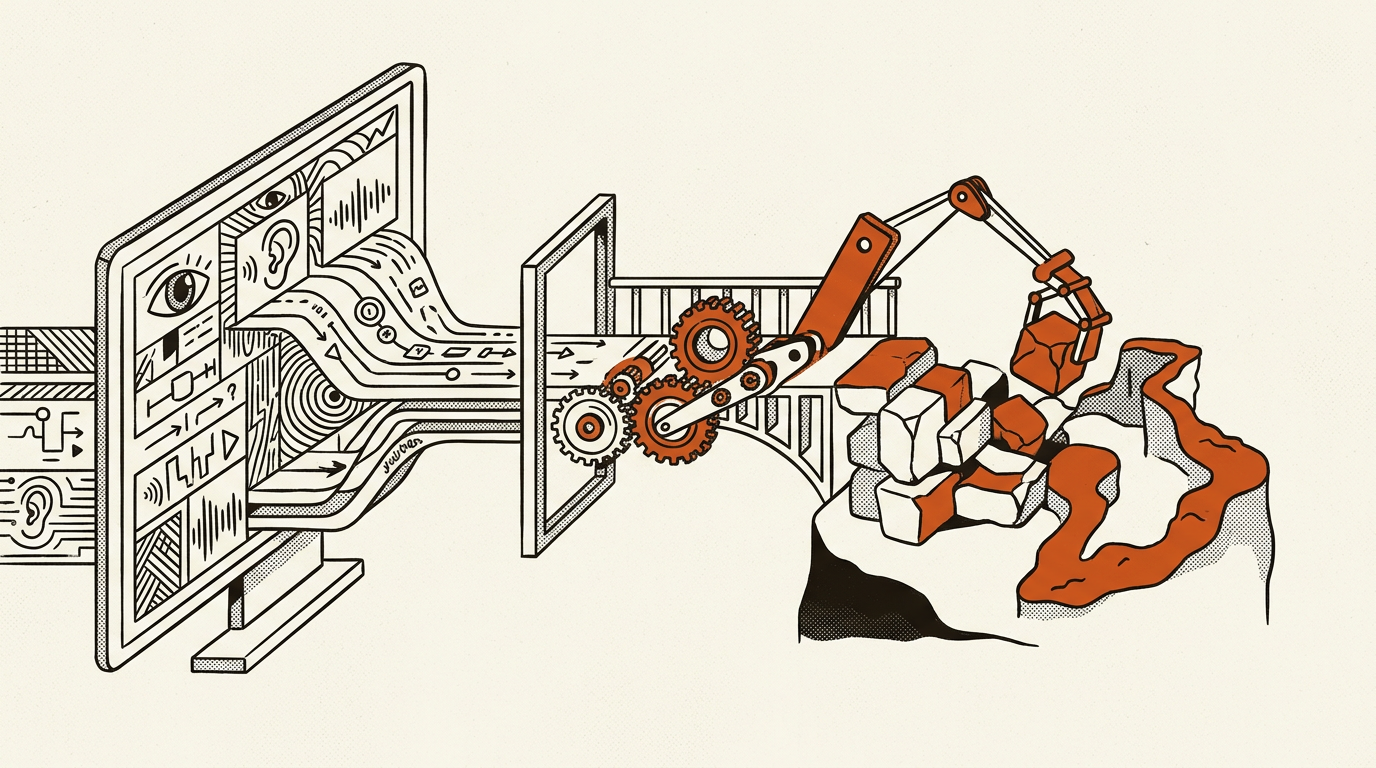
For all the noise about AI this year, most of it has happened on a screen. The models write, draw, code and reason — but they live in the digital world, manipulating text and pixels. The hard frontier, the one behind every breathless humanoid-robot demo you've seen, is getting an AI to do something in the physical world: to look at a real, messy scene, understand a plain-English instruction, and move a real arm to carry it out. The approach driving most of the recent progress has an unlovely name and a simple idea behind it: the vision-language-action model, or VLA.
One model, from seeing to moving
A VLA does exactly what its name says. It takes in vision — camera images of what's in front of the robot — and language — an instruction like "pick up the red block and put it in the bowl" — and it outputs actions: the actual motor commands that move the robot's joints and gripper. Perception and instruction go in one end; physical movement comes out the other, from a single trained model.
That sounds obvious, but it's a real departure. For decades, getting a robot to do a task meant painstakingly hand-coding it, or training a narrow controller for that one task in that one setup — change the lighting or move the bowl and it broke. A VLA instead learns the mapping from "what I see and what I'm told" to "what to do," from large amounts of demonstration data — typically humans tele-operating robots through thousands of tasks.
The clever part: it stands on a language model's shoulders
The reason VLAs suddenly work better than decades of prior robotics is that they don't start from scratch. They're built on top of pretrained vision-language models — the same kind of model that can already look at a photo and describe it, having absorbed objects, words and a rough common sense from vast internet data. A VLA takes that semantic understanding and teaches it to also output movement.
The trick for doing that is almost cheeky: turn actions into a kind of language. Robot movements get encoded as tokens, so the model can "predict the next action" the same way a chatbot predicts the next word — one transformer, generating motion instead of prose. (Some newer systems instead borrow image-generation's diffusion techniques to produce smooth, continuous motions.) Because the model inherits the language model's grasp of concepts, it can do things older robots couldn't: told to "pick up the extinct animal," a well-known Google system reached for a toy dinosaur — a flicker of semantic reasoning transferred straight into a physical act.
The landmark work here is public and well-documented: Google DeepMind's RT-2 in 2023 showed web knowledge transferring into robot control, and the Open X-Embodiment project pooled data across many different robots to train more general controllers. That lineage — plus a wave of newer efforts from dedicated robotics-AI labs — is the engine underneath today's general-purpose robot and humanoid push. It's the same instinct as giving a chatbot tools so it can act rather than just talk — only here the "tool" is a body.
Why it isn't solved yet
It's easy to watch a slick demo and assume robots are basically done. They are not, and the honest reasons are worth knowing.
Data is the wall. A language model can train on much of the internet. A VLA needs examples of robots physically doing things — and that data is scarce, slow and expensive to collect, usually requiring a human to tele-operate a real machine. There is no trillion-token web of robot motion to download. This scarcity, more than any single algorithm, is what gates progress.
The physical world is unforgiving. A chatbot that's occasionally wrong is annoying; a robot arm that's wrong even a few percent of the time near a person or a wine glass is a problem. Actions have consequences that text doesn't, so the reliability bar is far higher — and generalising to a genuinely new object, room or task is still where these systems are weakest.
The easy things are the hard things. What humans find effortless — dexterous fingers, balance, picking up a soft or oddly-shaped object — remains extraordinarily difficult for machines, while abstract reasoning came comparatively easily. VLAs have made real headway on this old puzzle, but they're nowhere near human dexterity or robustness, and the polished demo reels are, as ever, the cherry-picked best of many attempts.
The takeaway
The vision-language-action model is the bridge the field has been looking for between AI that thinks and machines that move — and it's the reason the robot demos suddenly look less like scripted puppetry and more like genuine, if fragile, understanding. It's also why "this is the year of humanoid robots" has been said about several years running. The brain is finally arriving. The body, the data and the reliability are still catching up.
Ask Relay — he reads every question himself and replies personally by email.