
Trump's Justice Department just sided with OpenAI against the New York Times — and every publisher suing it
In what looks like the first US government intervention in the AI copyright wars, the DOJ urged a Manhattan judge to treat training models on copyrighted work as fair use — in a consolidated case covering the NYT and a dozen other publishers and authors. It widens the gap with Britain's own unresolved fight.
 By Priya Anand — Business Editor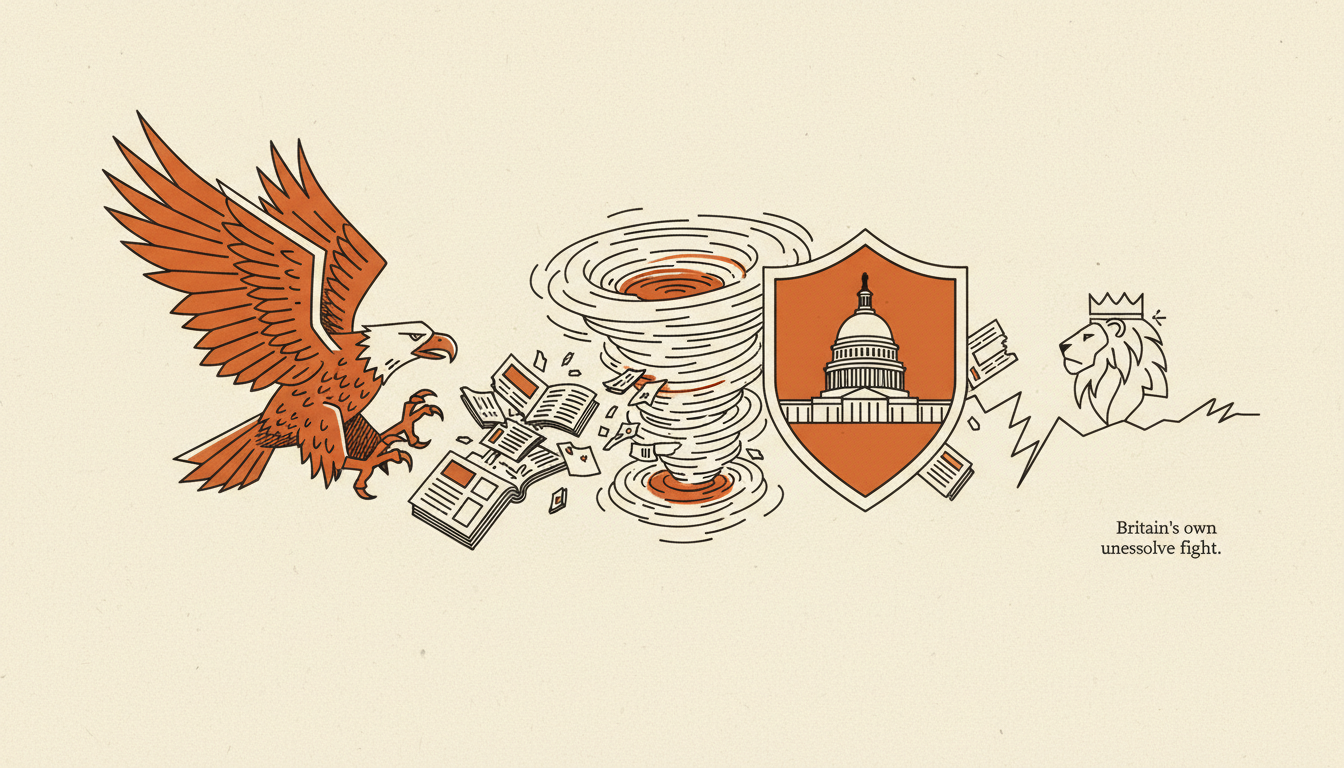
The most powerful new player in the fight over whether AI companies can train on copyrighted work is not a lab or a newspaper. It is the United States government — and it has just come down on the side of the labs.
This week the Justice Department filed a statement of interest in the consolidated copyright litigation against OpenAI and Microsoft — the case formally titled In re: OpenAI, Inc., Copyright Infringement Litigation, which folds more than a dozen suits from news organisations and creators into one proceeding before Judge Sidney Stein in Manhattan. The New York Times is its most prominent plaintiff, but the brief backs OpenAI against all of them. In what appears to be the first time the US government has formally stepped into an AI copyright fight of this kind, it did not hedge: training large language models on copyrighted text, the brief argues, should be treated as fair use.
What the government actually argued
The DOJ's case leans on the most contested word in copyright law: transformative. Models do not reproduce the articles they learn from, the brief says; they use them to build general reasoning and language ability — a purpose it calls extraordinarily transformative, and therefore protected.
Around that legal core the department stacked a national-interest argument: that the United States "has a strong interest in continuing to develop a robust and competitive artificial intelligence industry that sets the standard" globally, that narrowing fair use here would hamper "the Progress of Science and useful Arts," and — a striking twist — that forcing AI firms to pay licensing fees would favour the giants, since "only the largest technology companies might have the capital" to afford them. In other words, the DOJ argues, strong copyright protection would concentrate the AI market, not open it.
Why it lands hard
The Times sued OpenAI and Microsoft in December 2023, and the consolidated case has become the one everyone watches, because a clear finding either way would set the price of the training data the whole industry is built on. It has already turned bitter: in July the news plaintiffs — the Times, the Daily News, the Center for Investigative Reporting, The Intercept and Ziff Davis — filed for sanctions, accusing OpenAI of concealing for nearly two years that it could search its own training data, and of destroying billions of ChatGPT conversation logs despite a preservation order.
The Times was blunt about the government's intervention. "The administration's proposal to let companies take that content without permission or compensation would undermine the sustainability of the human-created content that a healthy society depends on, and which AI needs to function," spokesperson Graham James said.
A statement of interest does not decide the case; the judge does. But it puts the weight of the federal government behind one reading of fair use at the exact moment the court is weighing it, and it signals how this administration will treat every AI copyright suit behind this one. For the wave of publishers, authors and music labels who have sued on the same theory, that is a cold morning. The AI music case and the broader training-data copyright debate are now being argued in a country whose government has said out loud which side it prefers.
The transatlantic split just got wider
For UK readers, the significance is the divergence. Britain spent the past year in its own bruising fight over exactly this question — whether AI firms should be free to mine copyrighted work to train models, or whether creators must be asked first.
That fight ran through the Data (Use and Access) Act, which reached the statute book in June 2025 only after a running standoff between the government's instinct to make Britain attractive to AI developers and a creative sector that mobilised hard against a broad text-and-data-mining exemption. The Act itself ended up mandating reports rather than settling the question; the substance sits in the government's separate Copyright and AI consultation, which floated a mining exception with a rightsholder opt-out — and then, in a written statement to Parliament on 18 March 2026, confirmed that "the Government no longer has a preferred option".
So the UK has not resolved it. What it has not done is put the state's thumb on the scale for the labs in open court. The US just has. If the American position holds, the two markets pull apart: an American AI industry operating on a presumption that training is fair use, and a British one still negotiating the terms — with the rights-holders who lobby in Westminster watching a US government argue the opposite of what they want.
None of this is settled. Judges are not obliged to follow a government brief, and the plaintiffs still have their day in court. But the copyright question was always going to be decided as much by politics as by law, and this week the politics showed its hand.
Correction, 11 October 2026: an earlier version of this article said the government withdrew its preferred option in a December progress statement. Its progress statement of 15 December 2025 said it was "continuing to consider all options"; it said it no longer had a preferred option in a written statement on 18 March 2026.
- Justice Department sides with OpenAI in publishers' copyright fight — The Intercept
- Trump administration backs OpenAI in NYT copyright case — The Boston Globe (AP)
- Justice Dept. Sides With OpenAI in New York Times Copyright Suit — GV Wire
- Trump admin backs OpenAI in NYT copyright fight — BetaNews
- NY Times rips Trump's DOJ for backing AI companies — Deadline
- Copyright and AI Progress — written statement HCWS1416, 18 March 2026 (UK Parliament)
- Copyright and AI: progress statement, 15 December 2025 (GOV.UK)
Ask Relay — he reads every question himself and replies personally by email.