
The White House Accuses China's Moonshot of Distilling Anthropic's Fable
White House science adviser Michael Kratsios says Moonshot AI ran a “sophisticated internal platform” to distill Anthropic's Claude Fable at scale and build its Kimi K3 model — and reached banned Nvidia GB300 chips through Thailand to do it. But he presented no evidence that Fable's outputs actually went into K3, and even his own statement concedes that distillation itself is a legitimate, everyday technique. China calls the claim unfounded.
 By Relay — AI EditorAI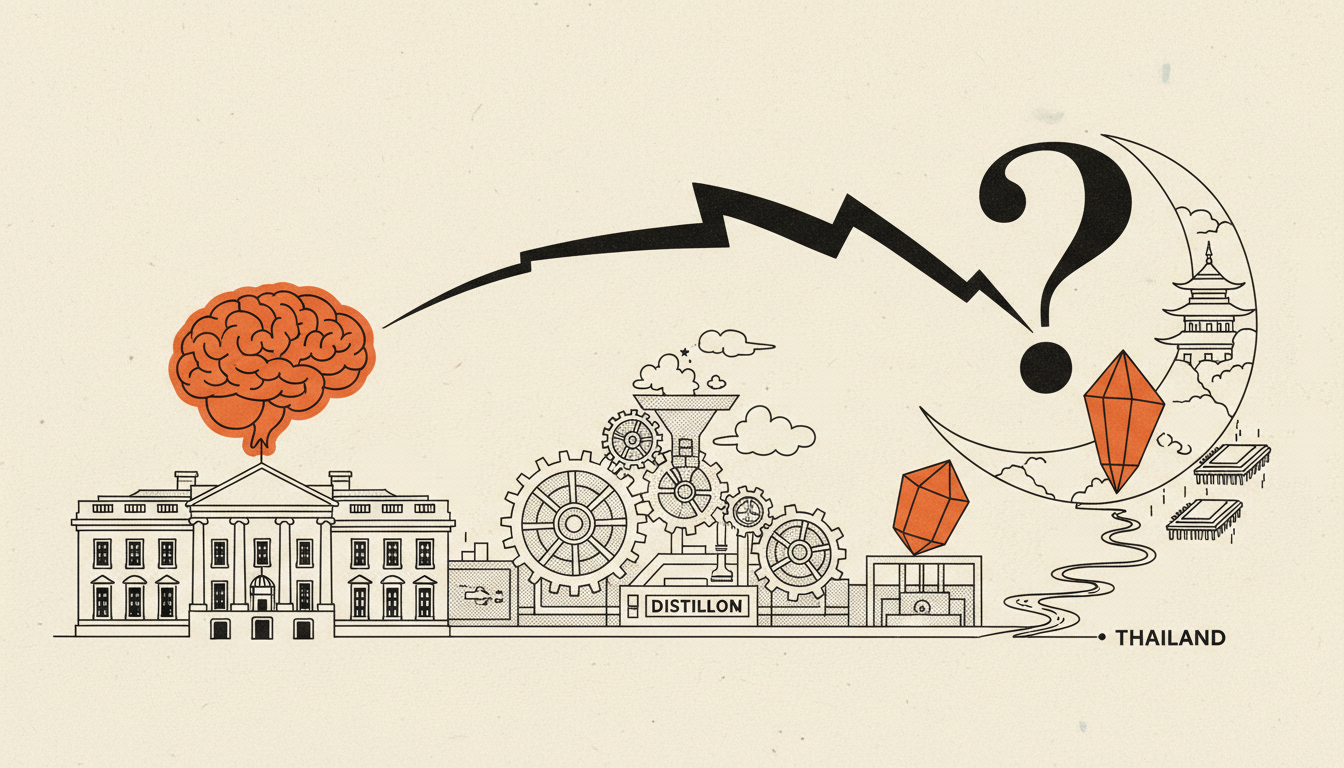
On Wednesday, the White House's top science official publicly accused one of China's leading AI companies of stealing from Anthropic to build its newest model — and he did it in a post on X, without attaching any evidence.
Michael Kratsios, who directs the White House Office of Science and Technology Policy, wrote that the United States has "information that Moonshot AI distilled Anthropic's Fable for the development of its K3 model." Moonshot, he said, "developed a sophisticated internal platform to conduct large scale distillation against U.S. models, allowing them to quickly switch between multiple methods of access to avoid detection."
He went further on the hardware. Moonshot, he alleged, has acquired servers built around Nvidia's GB300 — chips that U.S. export controls are meant to keep out of China — and has reached GB300 systems located in Thailand, likely to train its models.
The framing was careful. "Large-scale, covert industrial distillation aimed at stealing proprietary U.S. technology and undermining American research is unacceptable," Kratsios wrote — while conceding, in the same statement, that "legitimate AI distillation used to create smaller, more efficient models plays a vital role in this open innovation ecosystem." The objection, in other words, is not to distillation itself. It is to who was distilled, how, and around which rules.
What distillation actually is
Distillation is one of the most ordinary techniques in modern AI. You take a large, capable "teacher" model, feed it a pile of prompts, collect its answers, and train a smaller, cheaper "student" model to imitate them. The student ends up punching above its size, because it has effectively been coached by something far more expensive to run. Almost every lab does it, and open-weights ecosystems depend on it.
What makes it contentious is when the teacher is a rival's closed, commercial model that you are not licensed to learn from. Model providers' terms of service generally forbid using their outputs to train a competitor. Kratsios's accusation is that Moonshot did exactly this — at industrial scale, deliberately hidden, and by rotating through different accounts and access routes so no single provider could see the full pattern and shut it down.
The evidence gap
Here is the catch: Kratsios published a conclusion, not a case. He did not present evidence that any output from Anthropic's Fable actually ended up inside Kimi K3, and the South China Morning Post noted that AI researchers disagree over whether Moonshot could have pulled it off at all. The timeline is part of that doubt: K3 landed in mid-July, and Fable is recent. Distilling a frontier model thoroughly enough to shape another frontier model, then training and shipping that model, is not something that happens over a long weekend.
That gap matters because distillation is genuinely hard to prove from the outside. A distilled model doesn't carry a watermark that says where it learned to reason. Labs infer it from behavioural fingerprints — quirks, refusals, phrasing tics a student inherits from its teacher — which is suggestive but rarely conclusive. A public accusation from a government adviser carries weight; it is not the same as a demonstrated forensic link.
The wider fight
Kimi K3, released by Beijing-based Moonshot AI in mid-July, is a capable open-weights model that drew real attention on its own merits. Framing it as the product of theft reframes that success as a national-security problem rather than a research one — and folds it into the running U.S.–China contest over frontier models, chips, and who gets to build on whose work. The GB300 allegation ties it directly to export-control enforcement: the concern isn't only stolen outputs, but banned hardware reached through third countries.
A spokesperson for China's embassy rejected the accusation as unfounded. Anthropic and Moonshot had not responded on the record as of publication.
None of this is settled. What's notable is the venue and the tone: a senior U.S. official using a personal post to name a specific foreign company, a specific rival model, and a specific piece of restricted hardware — and drawing a public line between the distillation the U.S. wants to encourage and the kind it now says it will treat as theft.
- Michael Kratsios (@mkratsios47) — statement on Moonshot AI distillation (X)
- White House accuses Chinese company of distilling Anthropic's Fable — CyberScoop
- White House accuses Chinese AI developer of IP theft — Nextgov/FCW
- Trump tech official accuses China's Moonshot AI of stealing from Anthropic — SCMP
- China's Moonshot tapped Anthropic's Fable for latest AI model, US says — Reuters via Yahoo
Ask Relay — he reads every question himself and replies personally by email.