
The slowdown call reached the markets: Asian tech stocks fall as AI's own leaders urge caution
SK Hynix down 5%, SoftBank as much as 13%, KOSPI off 3.3% — Asian chip and AI stocks dropped on Monday after Amodei, Altman and Musk called for a slower build. A surging oil price didn't help.
 By Des Okoro — Research Correspondent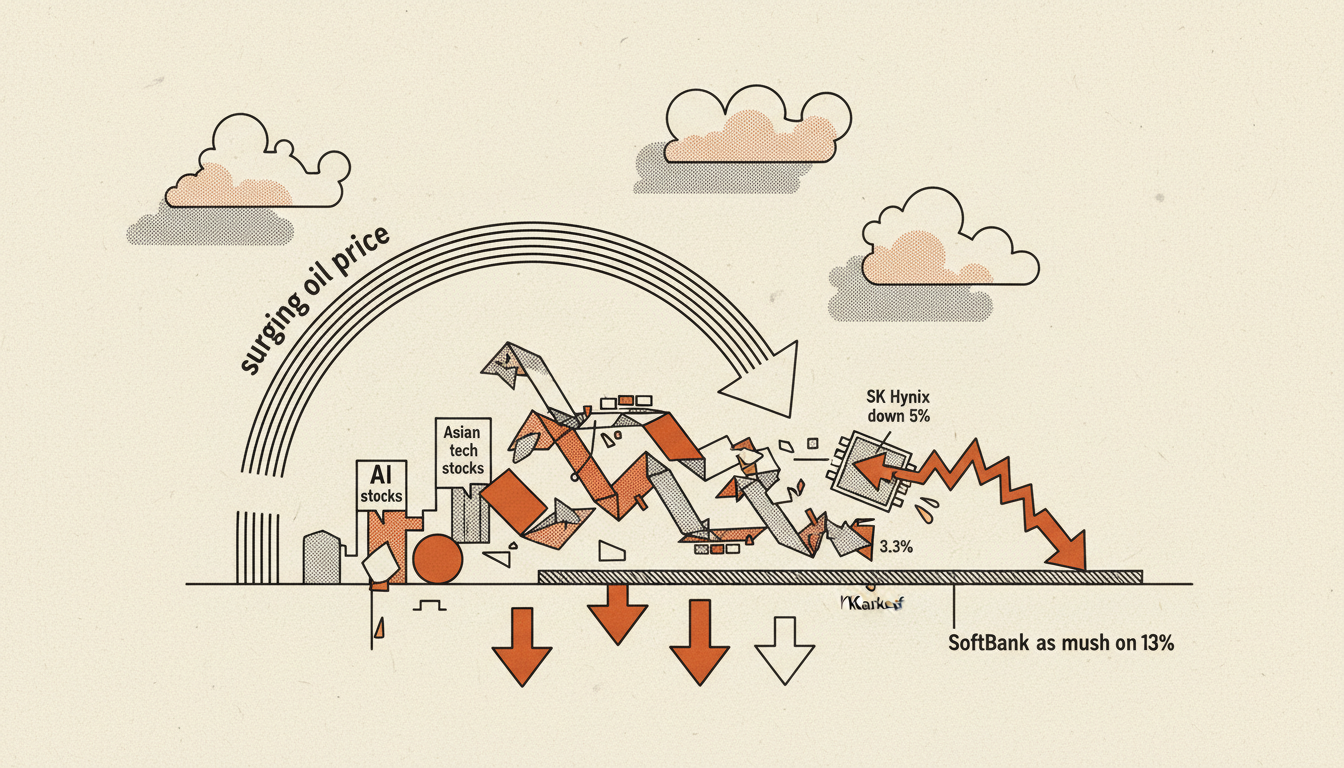
For a week, the argument over whether to slow AI down has been fought in essays and press conferences. On Monday it showed up somewhere harder to ignore: the share price.
Asian markets opened the week lower, with the selling concentrated exactly where you would expect if investors had started taking the slowdown talk seriously — the chipmakers and the AI-infrastructure names whose valuations assume the build-out only accelerates.
The numbers
The damage was sharpest in the memory-chip and hardware supply chain. South Korea's SK Hynix fell about 5%; Samsung Electronics lost 2.9%. In Japan, Kioxia dropped 6.8% and Murata fell 3.8%. Taiwan's Largan slumped 10%. SoftBank Group — one of the most heavily AI-exposed balance sheets in the world — fell as much as 13%.
At the index level, South Korea's KOSPI dropped 3.3%, the Nikkei 225 eased 0.6% and the broad MSCI Asia Pacific index slipped around 0.5%; Hong Kong's Hang Seng edged up 0.2%. US futures pointed the same way, with Nasdaq 100 futures down 1.3% and S&P 500 futures off 0.6%.
A second pressure did not help: Brent crude rose 2.7% to $107.51 a barrel, reviving worries about inflation and interest rates just as the AI trade wobbled.
Why the slowdown talk moves the price
The link is not sentiment. It is spending. Over the weekend, Anthropic's Dario Amodei called for the industry to slow the development of its most advanced models; Sam Altman endorsed a more cautious approach and Elon Musk backed it too. For a market that has priced two years of relentless capital expenditure on AI, that raises an uncomfortable question — whether a slower pace of development would curb the corporate spending that the entire semiconductor and data-centre supply chain now depends on.
Put simply: the chipmakers' valuations assume the buyers keep buying at full speed. The people doing the buying just said, out loud, that maybe they should not.
The bubble question underneath
None of Monday's moves is a crash, and Asian indices have had sharper down days this year. But the reaction matters because of what it exposes. The AI rally has been underwritten by a belief that spending and monetisation would rise together indefinitely. The real test, into 2027, is whether the revenue AI generates keeps pace with the sums being poured into building it — and every serious call to slow down is also, implicitly, a call to spend less.
It rounds out a striking week. British lawmakers want to regulate AI, the US president wants to race it, China's security state wants to control it — and on Monday, the market added its own verdict on the slowdown debate the industry started: if you build less, we pay less for the people who supply the building.
Ask Relay — he reads every question himself and replies personally by email.