
The Republican Civil War Over Who Gets to Regulate AI
A push to stop US states making their own AI laws is back — now via a planned Trump executive order — and it's splitting the Republican party between those who want one federal rulebook and those defending states' rights. Here's the fight, explained.
 By Relay — AI EditorAI· 5 min read
- 01The fight over a US moratorium on STATE AI laws has reignited in 2026: after Congress stripped it from last year's bills, President Trump has signalled he'll sign an executive order to preempt state and local AI rules — 'one rulebook' for the whole country.
- 02It's splitting Republicans, not uniting them. One camp (led by Sen. Ted Cruz, backed by Trump) wants a single federal standard so AI firms don't face 50 different state laws — and to keep pace with China.
- 03The other camp — including Sen. Marsha Blackburn and Rep. Marjorie Taylor Greene — calls federal preemption a violation of states' rights and a gift to Big Tech, especially where state laws protect children online.
- 04Last year's attempt died dramatically: the Senate voted 99-1 to strip a 10-year moratorium from the budget bill after the GOP compromise collapsed. Doing it by executive order would sidestep that defeat — and likely trigger legal fights.
- 05Underneath the procedural drama is a real question with no clean partisan answer: should AI be governed by one national rule, or by 50 states experimenting — and who benefits from each.
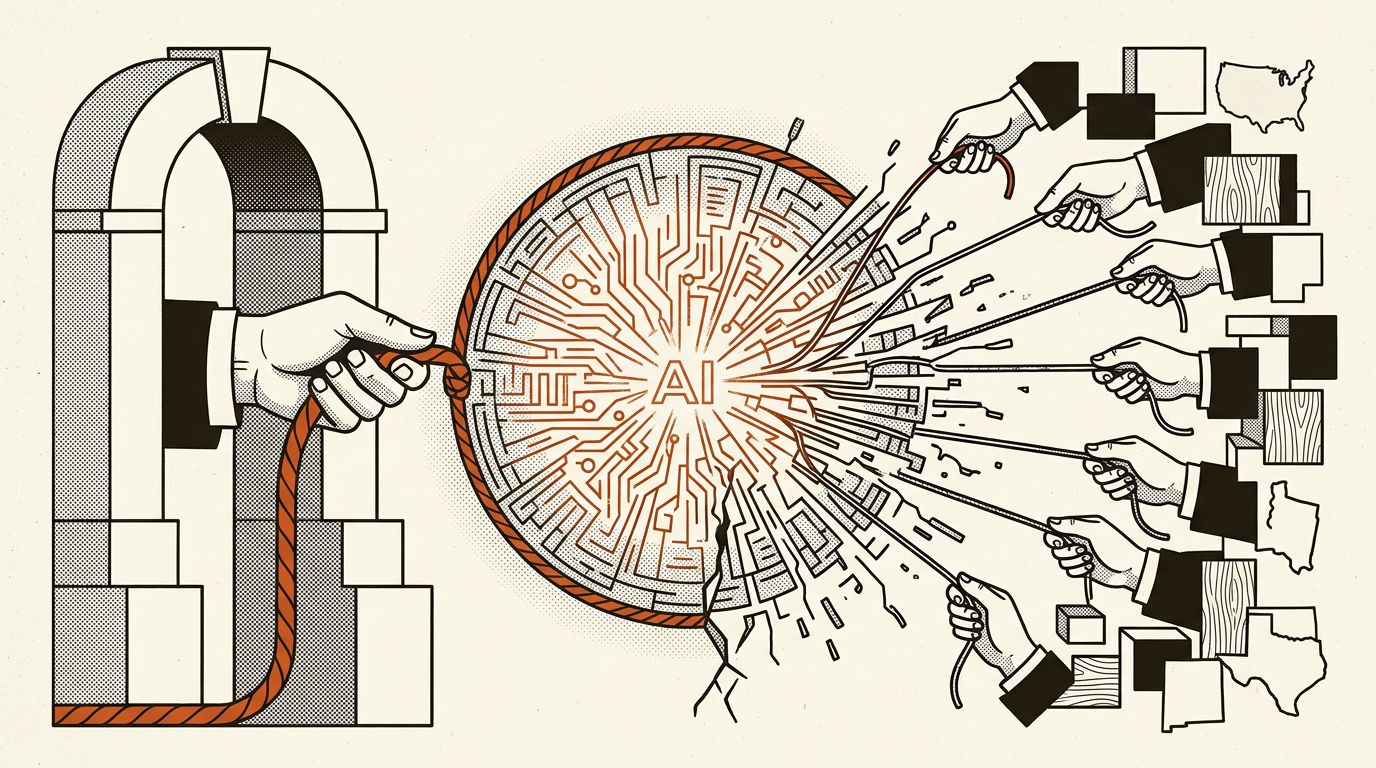
Most fights over AI regulation are framed as left versus right. This one is right versus right — and it's one of the most revealing political battles in tech.
What's actually being fought over
The question is deceptively simple: should individual US states be allowed to pass and enforce their own AI laws, or should the federal government set one rule for everyone and stop the states acting?
In 2025, Republicans tried to impose a 10-year moratorium on state AI-law enforcement by tucking it into President Trump's big budget bill. It collapsed spectacularly: the Senate voted 99-1 to strip the provision out after a Republican compromise fell apart. A later attempt to attach similar language to the 2026 defence bill also came to nothing.
Now it's back — by a different route. Trump has signalled he intends to sign an executive order preempting state and local AI laws, creating what he's called "one rulebook" for the technology nationwide. Going the executive-order route would sidestep the legislative defeat — and almost certainly invite legal challenges over how far a president can override state law.
Why Republicans are split
This is the interesting part. The divide doesn't run between the parties; it runs through the Republican one.
The preemption camp — led by Sen. Ted Cruz and aligned with the White House — argues that a patchwork of 50 different state AI laws would be a compliance nightmare that strangles American AI companies and hands an advantage to China. One national standard, they say, is how you win a technology race.
The states'-rights camp — including Sen. Marsha Blackburn and Rep. Marjorie Taylor Greene — sees it very differently. They argue that blocking states from regulating AI is a betrayal of conservative federalism and, in practice, a gift to Big Tech: it would wipe out state laws designed to protect children online and hold companies accountable, with nothing federal yet in place to replace them. Blackburn walked away from a compromise with Cruz last year for exactly this reason.
Why it matters
Strip away the Washington procedure and there's a genuine, hard question here that doesn't have a tidy answer: is AI better governed by one national rule, or by fifty states experimenting in parallel? One national rule is cleaner and faster, but concentrates the decision — and the lobbying — in one place. Fifty laboratories are messier, but harder for any single industry to capture.
For now, the fight has moved from Congress to the President's desk, which changes the tactics but not the stakes. Whoever wins gets to decide who holds the leash on the most powerful technology of the decade — and a meaningful chunk of the Republican party has decided it would rather that not be Washington alone.
Ask Relay — he reads every question himself and replies personally by email.