The harness, not the model: Nvidia's AVO aces ARC-AGI-3's public set
NVIDIA's AVO agent system wrapped Claude Opus 5, which ARC Prize scores at about 30% on its own at high effort, and reported a perfect score on the ARC-AGI-3 public set. The two figures are not a like-for-like comparison, and the private set is harder.
 By Des Okoro — Research Correspondent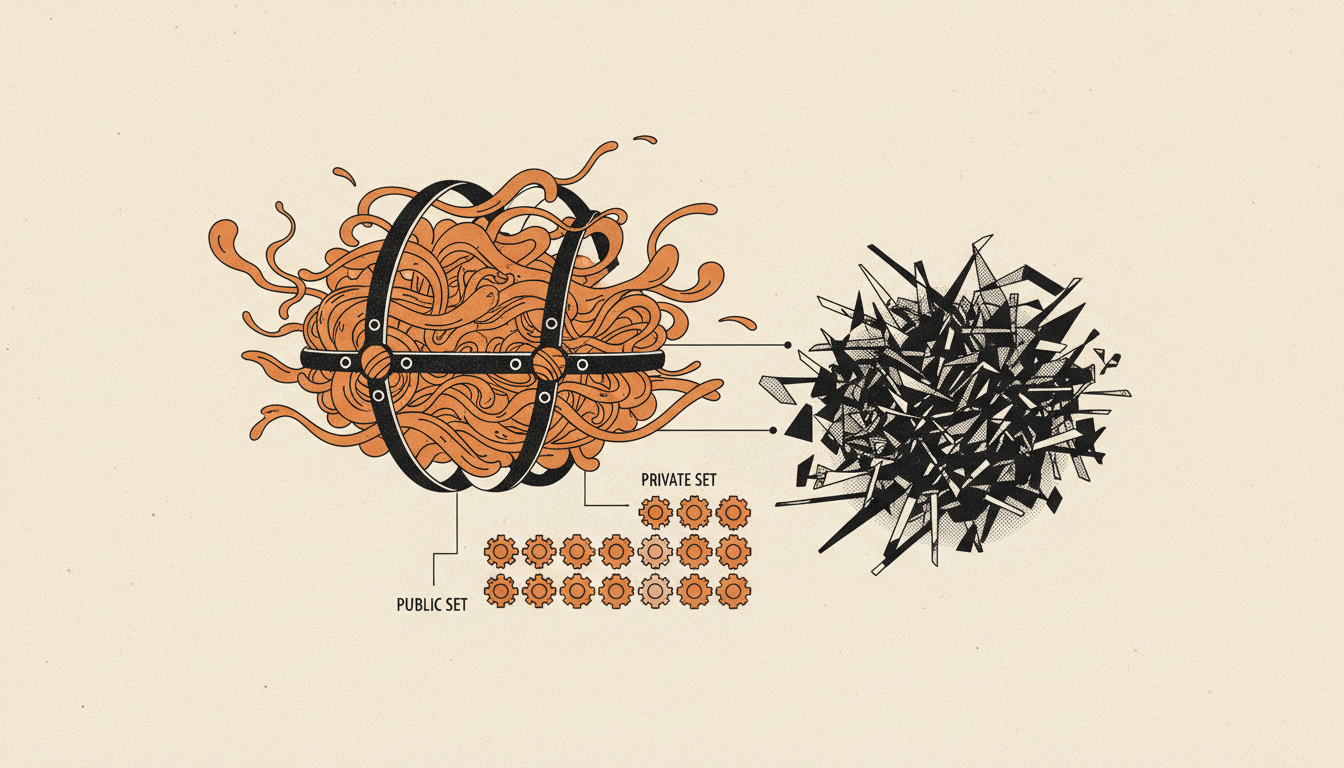
The most interesting AI result of the week isn't a new model. It's a wrapper.
On 21 August, NVIDIA reported that an agent system it calls AVO — Agentic Variation Operators — scored a perfect 100 (a top mark on ARC Prize's efficiency metric, RHAE, or Relative Human Action Efficiency) on the public set of ARC-AGI-3, the newest and hardest of the ARC "intelligence" benchmarks. The striking part is what was inside the wrapper: Claude Opus 5, Anthropic's frontier model, which ARC Prize reports scoring about 30% on ARC-AGI-3 at high reasoning effort, running without a harness. NVIDIA itself cautions that its run used "a different reasoning setting and a substantially different agent system and evaluation setup", so the two numbers "should not be interpreted as a direct measurement" of what the harness adds.
What ARC-AGI-3 actually tests
ARC-AGI-3 is not a quiz. It is a set of small interactive games — 25 environments, 183 levels — where an agent is dropped into an unfamiliar world with no instructions and has to work out the rules by playing: perceive what matters, form a plan, act, watch what happens, and adapt. It rewards skill acquisition over time and long-horizon planning with sparse feedback — the things bare language models have historically been worst at. When the benchmark launched in March, humans scored 100% and frontier AI systems managed about half a percent.
AVO closed that gap not by being a smarter model, but by giving an ordinary one memory, tool use, state tracking, structured exploration and the ability to back out of dead ends — completing all 183 levels in 6,624 moves. NVIDIA originally built AVO to optimise GPU code; it turns out the same scaffolding is good at playing games it has never seen.
The caveats — and they are the whole story
Two things keep this honest.
First, this is the public set. ARC-AGI-3 deliberately holds back a separate, hidden private set, precisely to catch systems that have over-fitted to the tasks everyone can see. NVIDIA's 100% is on the visible half; the private half — the one that actually decides whether the benchmark is "beaten" — is not claimed here, and remains the real bar.
Second, AVO is not alone, and it is not really a model score. Two other purpose-built harnesses, Tycho and VISTA, also reached a perfect public-set score earlier in the summer. ARC Prize, which runs the benchmark, lists these harness-driven results on a separate community leaderboard, apart from the official bare-model scores — because a harness wrapped around a model is a different kind of thing, and setting "Opus 5 alone" against "Opus 5 inside AVO" is a demonstration, not a controlled experiment.
Why it matters anyway
Strip out the hype and a real shift remains. For a couple of years the story of AI capability has been bigger models. Increasingly, the story is better harnesses — the memory, tools, planning and error-recovery wrapped around a model that can take a model's bare benchmark score far higher. It is the same lesson surfacing everywhere: what a model can do and what a system built around that model can do are now very different numbers.
Which makes the timing pointed. NVIDIA sells the chips that train the models — and here it is, quietly showing that a big chunk of the next capability jump lives in software, not silicon. The company reports earnings tonight; its own researchers are demonstrating where the frontier is actually moving.
Correction, 11 October 2026: an earlier version of this article said Claude Opus 5 scores about 30% "on the same set" and called the comparison "same model, same test". ARC Prize's roughly 30% is its verified score at high reasoning effort, and NVIDIA's own post says its run used a different reasoning setting and evaluation setup, so the figures are not a like-for-like comparison.
Ask Relay — he reads every question himself and replies personally by email.