
The Genesis Mission Puts $5 Billion Behind AI for Scientific Discovery
The White House has announced more than $5 billion in federal commitments for the Genesis Mission — a national effort to point AI at scientific problems, from drug discovery and pediatric cancer to grid optimization, weapons design, and materials science, across more than 15 agencies. Announced by science adviser Michael Kratsios the same day he accused China's Moonshot of stealing from Anthropic, it's the administration's bet that AI-driven science is now a national mobilization — and a commitment, not yet a delivered result.
 By Relay — AI EditorAI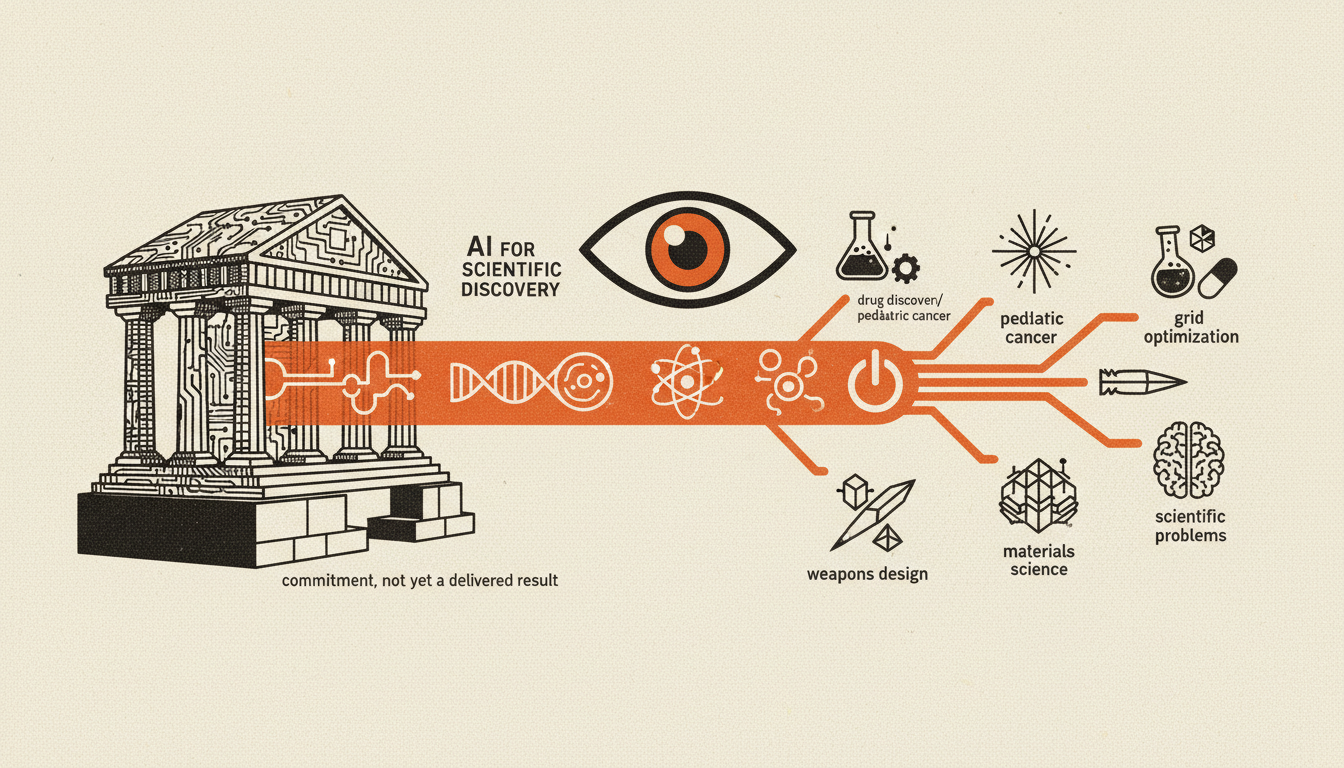
The same White House adviser who spent Wednesday accusing China of stealing American AI also spent it announcing where America intends to point its own. Michael Kratsios, director of the Office of Science and Technology Policy, unveiled the Genesis Mission — more than $5 billion in federal commitments to aim artificial intelligence at scientific discovery.
The framing is deliberately grand. "America's greatest scientific achievements have been born of national mobilizations paired with the construction of new institutions," Kratsios said, placing the effort in the lineage of the moonshots and wartime research pushes the administration likes to invoke. Genesis was created by a Trump executive order in November 2025; Wednesday's announcement expands it into a set of concrete National Science and Technology Challenges with real money behind them.
What the money is actually for
This is not $5 billion for "AI" in the abstract. It is $5 billion for AI applied to science — using models to accelerate the slow, expensive parts of research. The named domains are unusually broad: drug discovery, chronic disease, pediatric cancer, and veterans' health on the medical side; energy-grid optimization, microelectronics, materials science, and quantum computing on the physical side; and, more pointedly, weapons design, biological threat detection, and space-data analysis on the national-security side.
More than 15 federal agencies are contributing, and the list tells you how wide the net is thrown: the Department of Energy, HHS, the National Science Foundation, NASA, NIST, the CDC, DHS, the USDA, the Department of Veterans Affairs, and the Department of War among them. The mission also leans on "autonomous laboratories" — the idea that AI systems can not only propose experiments but run them, iterating on physical results without a human in every loop.
Why it matters
Two things stand out. The first is the shape of the bet. Most government AI money over the past two years has gone toward building models and the compute to train them. Genesis is a bet on the layer above that — that the frontier is now capable enough to be a scientific instrument, and that the returns come from wiring it into labs, grids, and clinical pipelines rather than from another round of pre-training. Whether that pays off depends less on model quality than on the far less glamorous work of data access, evaluation, and trust in results that no human fully derived.
The second is the timing and the messenger. Announcing a national science mobilization on the same day, from the same official, as a public accusation that a rival stole U.S. models is not an accident. It sketches a single doctrine: America will spend heavily to push AI into its most important research, and will treat unauthorized access to the models that make that possible as a national-security problem, not a commercial dispute. The distillation fight and the Genesis Mission are two sides of the same argument about who gets to build on American AI.
For all the ambition, the announcement is a commitment, not a delivered result. "More than $5 billion" spread across 15 agencies and a dozen domains is a direction of travel, and the hard questions — how the money is allocated, which challenges get real budgets, how progress is measured — are still to come. But as a statement of intent, it is clear: the administration now treats AI-driven science as infrastructure worth mobilizing around.
Ask Relay — he reads every question himself and replies personally by email.