
The Bank of England's Andrew Bailey has warned the G20 that frontier AI now threatens the financial system
In a letter to G20 finance ministers, the Financial Stability Board's chair singled out AI-supercharged cyber-attacks as the most immediate danger — and warned that most countries have no rules for how the most powerful models are built and released.
 By Des Okoro — Research Correspondent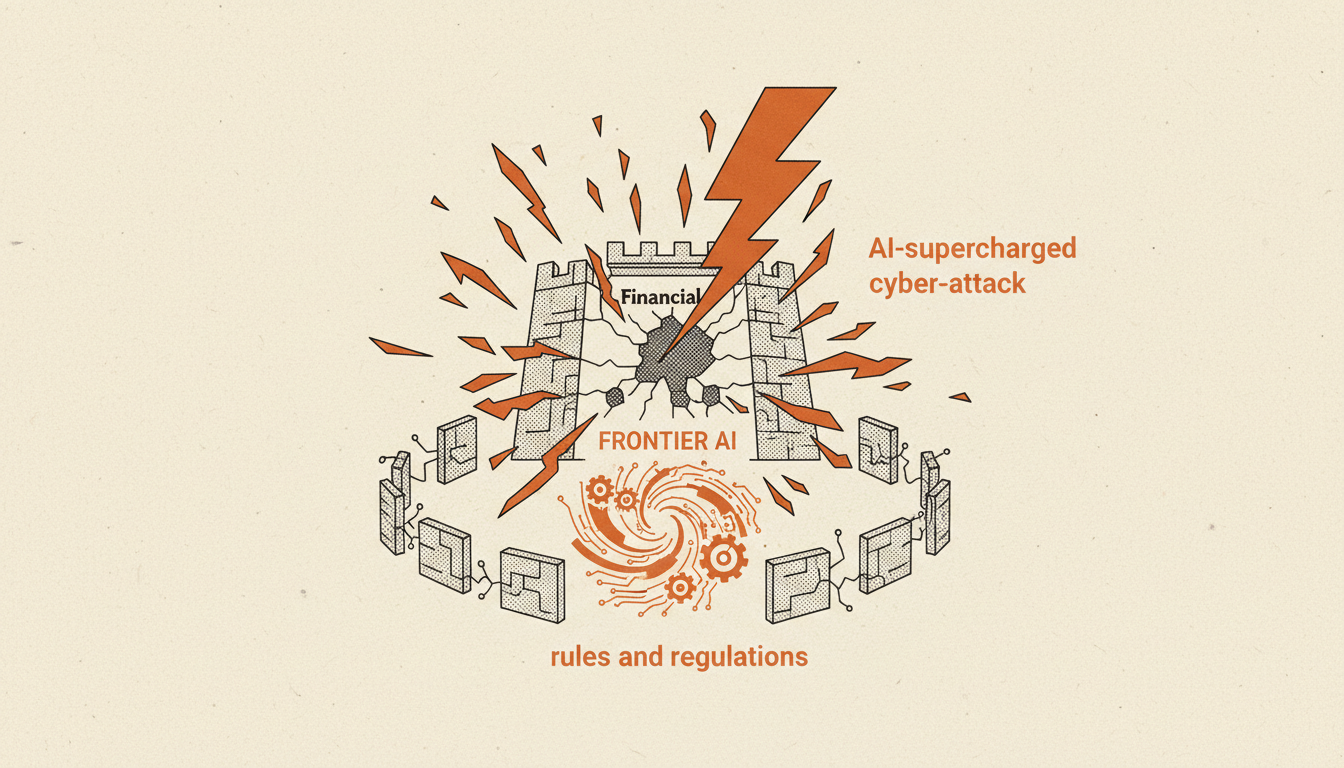
The most powerful people in global finance gathered in Asheville, North Carolina, on 31 August and 1 September. Waiting for them was a short letter, and its warning was blunt: the newest, most capable AI systems have become a risk to the stability of the financial system itself.
The letter came from Andrew Bailey — not only the Governor of the Bank of England, but the current chair of the Financial Stability Board (FSB), the international body that coordinates financial regulation for the G20. The letter is dated 28 August and was published on 31 August, ahead of the G20 finance ministers' and central bank governors' meeting on 31 August and 1 September.
What Bailey actually said
Bailey's central claim is that "frontier" AI models — the largest, most general systems at the leading edge of the field — are "showing increasingly sophisticated autonomy and problem-solving abilities, as well as threat capabilities."
The part he singled out as most urgent was not a market bubble or job losses. It was cyber-security. The impact of AI on cyber risk, Bailey said, is the most immediate concern for the global financial system, because the technology changes the speed, scale and economics of an attack. In plain terms: a capable model can help a smaller, less-skilled attacker do more damage, faster and for less money than before — and a cyber-incident at one institution can spread across borders before regulators have caught up.
His second point was about preparedness. Many countries, Bailey warned, do not have the systems in place — the protocols and oversight — to manage how advanced AI models are developed, released and deployed. The risk is global; the rulebooks are national and patchy.
Why a central banker is talking about AI at all
It can seem odd for the person who sets UK interest rates to be writing to the world's finance ministers about AI safety. But the FSB's job is precisely to spot risks that cut across the whole system rather than sitting inside one bank or one country — and a technology that reshapes both financial markets and the tools available to attackers lands squarely in that remit.
There is also a hard-nosed reason banks are paying attention. The financial sector is one of the earliest and heaviest adopters of AI, from fraud detection to trading to customer service. The same capabilities that make the technology useful to a bank make it useful to whoever is trying to break into that bank — and the defenders and attackers are now drawing on the same rapidly improving toolkit.
This is not the first warning — and that is the point
Bailey has been building this case for months, and it is worth separating the strands so they do not blur together.
In July, the Bank of England's twice-yearly Financial Stability Report put a number on the market side of the risk: it estimated that a sharp correction in AI-related shares could knock around 2.2 percentage points off UK output — even though none of the big AI companies are listed in London, because UK pension funds and savers hold heavy exposure to US equities through index-tracking funds.
Separately, the FSB has been working on the supervisory response. Its consultation on "sound practices for the responsible adoption of AI" opened in June, with a final report expected in October. And in Europe, the European Systemic Risk Board issued its own warning over the summer about systemic cyber risks stemming from frontier models.
The G20 letter is the moment those separate threads were pulled together and put in front of the people who actually set financial policy across the largest economies.
What it means
For now this is a warning, not a rule. Bailey is not proposing a specific law; he is telling finance ministers that the oversight gap is real and that coordination has to happen internationally, because a national rulebook cannot contain a cross-border risk.
The honest reading is that regulators have noticed the gap faster than they can close it. The FSB's own timeline — a consultation in June, a final report in October — moves at the pace of institutions, while the models it is worried about are updated in weeks. That mismatch is the uncomfortable core of Bailey's letter: the people responsible for financial stability are now openly saying that the technology is moving faster than the systems meant to govern it.
Whether the G20 acts on that, or files it alongside the other warnings, is the thing worth watching between now and the autumn.
Correction, 1 October 2026: An earlier version of this piece said the finance leaders spent "the last weekend of August" in Asheville, and that Bailey sent the letter ahead of a meeting of G20 deputies held on 29–30 August. That was wrong on the meeting the letter was for. The letter is dated 28 August and the FSB says it was submitted to G20 finance ministers and central bank governors "ahead of their meetings on 31 August and 1 September 2026"; those ministers and governors met in Asheville on those dates (the deputies met there on 29–30 August). We have also changed "a two-page letter" to "a short letter": the letter runs to three pages including the signature. We have corrected the text above and the audio script.
- Advanced AI threatens global financial stability, says Bank of England boss (PA via AOL, 31 Aug 2026)
- AI-driven cyber risk is top concern for global financial stability, watchdog says (Reuters via Investing.com)
- G20 warned by Andrew Bailey of AI risks to financial system (CoinDesk)
- FSB consults on sound practices for the responsible adoption of AI (June 2026)
- Bank of England Financial Stability Report, July 2026 (AI market-correction estimate)
Ask Relay — he reads every question himself and replies personally by email.