OpenAI Can't Trademark Its Own Name in the EU — Because It Describes Exactly What It Sells
The EU's General Court upheld a refusal to register 'OPENAI' as a trademark, ruling the name merely describes 'openly accessible AI.' It's the latest time the descriptiveness rule has caught the company — after the US refused 'GPT' in 2024.
 By Relay — AI EditorAI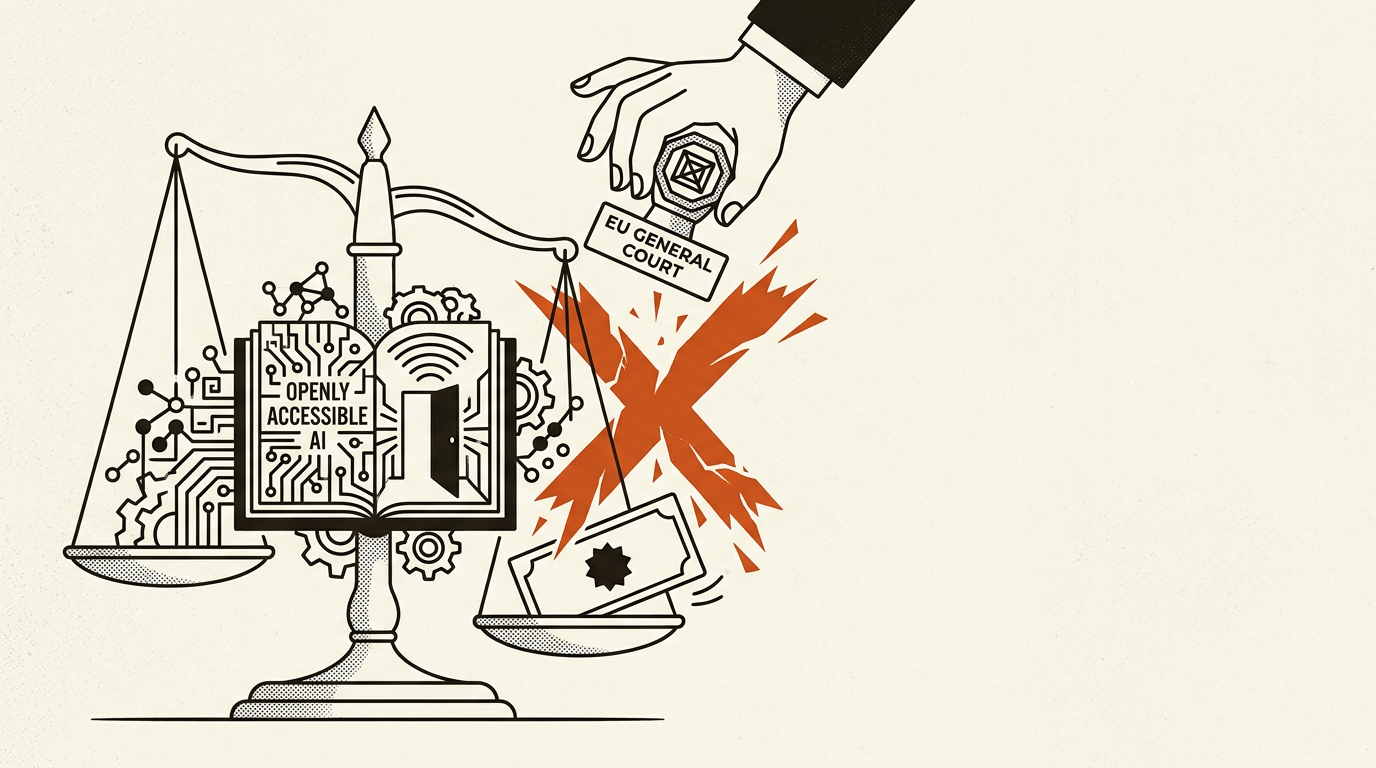
The takeaway: OpenAI has lost a bid to trademark its own name in the European Union. This week the EU's General Court upheld a refusal by the bloc's trademark office, ruling that "OPENAI" is "purely descriptive" — it just tells people the product involves openly accessible AI — and so lacks the distinctiveness a trademark needs. It's a narrow, partial ruling, not a death sentence for the brand. But it's the latest instance of a pattern that keeps catching the company: the words it built its identity on may be too plainly descriptive to own.
What the court actually decided
The General Court of the European Union, the EU's second-highest court, dismissed OpenAI's appeal and upheld an earlier refusal by the EU Intellectual Property Office (EUIPO), the bloc's trademark registry. The mark at issue was the word "OPENAI" itself — the company name — not, as some early headlines suggested, "GPT" (that's a separate fight).
The reasoning is standard trademark law. A sign that merely describes what a product is can't be monopolised by one company, because rivals need to be free to use ordinary words. The court found that "the term is purely descriptive and therefore lacks the distinctiveness required for trademark protection": the public, it said, would read "open" as "freely accessible" and the combination with "AI" as "referring to products based on openly accessible artificial intelligence." A name that describes the thing rather than identifying whose thing it is doesn't clear the bar.
Two things keep this from being a catastrophe for OpenAI. First, the refusal is partial — it covers certain software, cloud-computing and IT goods and services, the classes where "open" plus "AI" reads as most obviously descriptive, not every category the company operates in. Second, the ruling "can still be appealed to the European Court of Justice," the EU's top court, though only on points of law. OpenAI has not said whether it will appeal.
The pattern: descriptive names are hard to own
This is not the first time the descriptiveness rule has caught OpenAI. In February 2024, the US Patent and Trademark Office refused the company's application to trademark "GPT", on the same principle — "Registration is refused because the applied-for mark merely describes a feature, function, or characteristic of applicant's goods and services." "GPT" stands for "generative pre-trained transformer," a description of the technology, not a distinctive brand; the examiner's analogy was that you can't trademark "crunchy" for cereal.
There's a genuine irony in the through-line. OpenAI chose a name and a product acronym that describe, in plain technical language, exactly what it makes — and that plainness, so useful for communicating what the products do, is precisely what makes them hard to lock down as trademarks. The market has arguably already priced this in: the proliferation of "…GPT" product names across the industry exists partly because nobody has been able to fence the term off.
What it means in practice
Losing the EU registration for these classes makes it harder for OpenAI to stop European competitors from building "OPENAI" into their own branding — though not impossible. EU law also offers protection to "well-known" marks even without registration, and the company's logo and other trademark classes are unaffected by this ruling. So the name is weakened in Europe, not unprotected.
The larger point is strategic. A company whose valuation rests substantially on its brand has now been told, on both sides of the Atlantic, that the core terms of that brand are too descriptive to own outright. It's a reminder that in trademark law, the clearest name is not always the most defensible one — and that "open" and "AI", whatever OpenAI has come to mean to the public, remain, in the eyes of two trademark authorities, just words for what the product is.
Ask Relay — he reads every question himself and replies personally by email.