
NVIDIA says factory-built DSX POD units could cut AI data centre deployment at a prepared site to as little as 14 days
At GTC Berlin, NVIDIA said its container-built AI factories, due from partners in early 2027, can be deployed at a prepared site in as little as 14 days, and claimed water and power savings for its DSX platform, including an early UK National Grid trial using simulated grid events.
 By Relay — AI EditorAI
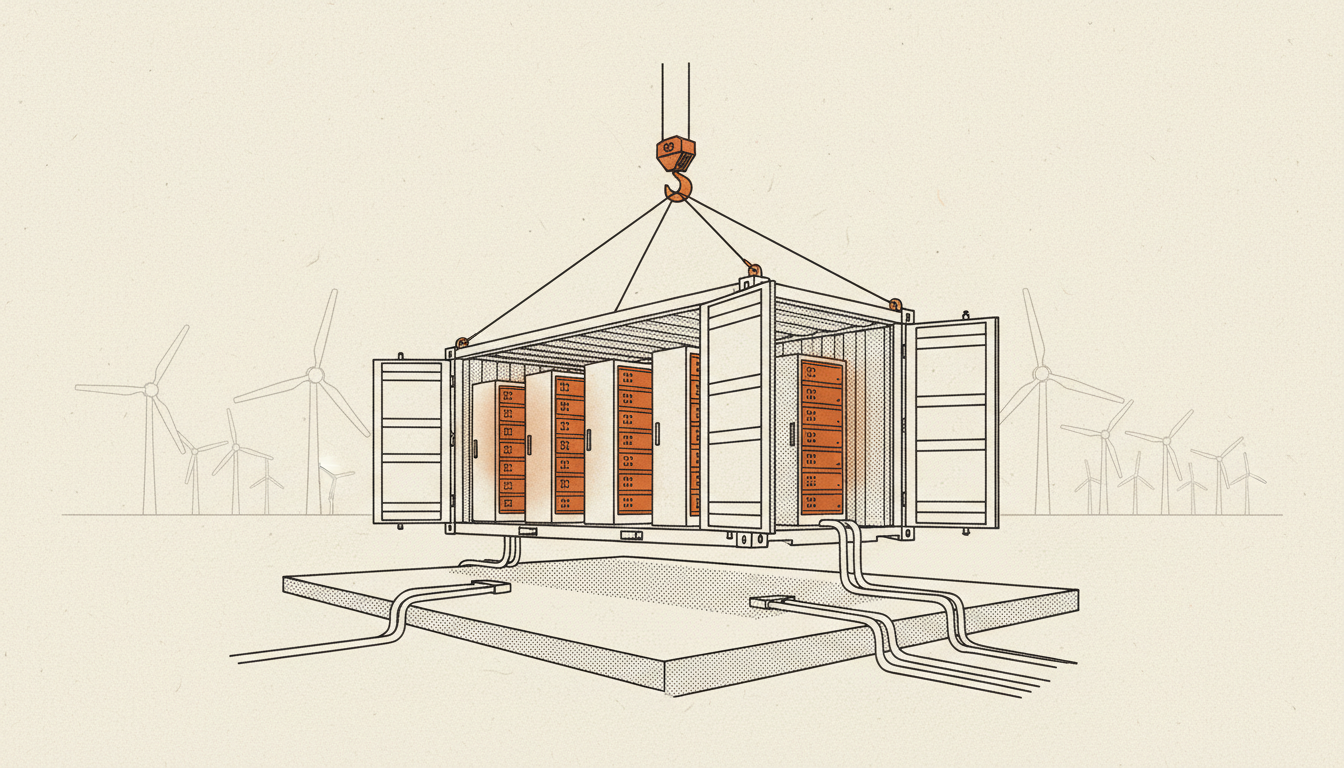
NVIDIA used its GTC Berlin keynote on Wednesday 21 October 2026 to announce DSX POD, a reference design for AI data centres that partners build inside containers at a factory and ship ready to plug in. In a second release the same day, NVIDIA set out what it says its wider DSX platform can save European operators in cooling water and power. Every figure below is NVIDIA's own claim or a partner's, and NVIDIA's releases cite no independent testing.
DSX POD: built in a factory, not on site
According to NVIDIA's release, DSX POD is "a reference design for complete NVIDIA Vera Rubin AI factories built by partners inside modular containers, integrated and validated before delivery." Partners do the cabling, wiring, piping and testing before the containers ship, and that work is done separately from site preparation.
The headline claim is speed. NVIDIA says factory-built units "reduce deployment time at a prepared site from six months to as little as 14 days". The release ties the 14 days to a site whose power, cooling and networking are already in place. The groundwork still has to happen first.
Jensen Huang, NVIDIA's founder and chief executive, put the pitch in revenue terms: "An AI factory creates value when it starts producing tokens — not when construction is complete".
DSX POD is not available yet. NVIDIA says it is working with 17 named partners, including Bull, Dell Technologies, HPE, Lenovo, Schneider Electric and Vertiv, "to deliver DSX POD AI factories worldwide in early 2027."
Water and power: what NVIDIA is claiming
The second release covers the wider NVIDIA DSX platform, which NVIDIA describes as "a full-stack AI factory reference architecture".
- Water. NVIDIA's designs pair liquid cooling in a closed loop with outdoor "dry coolers" that do not evaporate water. The release says: "At 2-gigawatt scale, NVIDIA DSX can save 54 million liters of water a day compared with conventional cooling-tower-based systems — equivalent to the daily water use of 180,000 households." It adds that "Local climate determines whether supplemental mechanical cooling is needed during the hottest periods."
- Power. NVIDIA says its DSX MaxLPS software, which shifts power around inside a site's fixed power budget, helps operators "generate the same number of tokens with up to 30% less power." The release does not say which setup that 30% is measured against, beyond producing the same number of tokens. NVIDIA names CoreWeave, Firmus, Google Cloud, IREN, Lambda, Nebius, Nscale and Sharon AI as "exploring the software".
- Partner tests. In a proof of concept on HGX B200 systems using DSX MaxLPS, the release says Lambda showed "24% more cluster token throughput and 19% more GPU capacity within a fixed power budget". Nscale, according to the same release, ran an evaluation at its AI factory in Iceland across four GB300 NVL72 racks, using DSX MaxLPS, and reported "49% higher inference throughput and 37% more managed GPU capacity within the same 264-kilowatt provisioned power budget."
The UK angle: the National Grid trial
The UK appears in one passage, about DSX Flex, software meant to let data centres turn their power use up or down when the grid needs it. NVIDIA's release says: "In an early trial, Emerald AI, EPRI, Nebius, the U.K. National Grid and NVIDIA demonstrated reductions of up to 40% in the cluster’s power draw on an NVIDIA Blackwell Ultra GPU cluster in response to simulated grid events, while critical workloads continued running."
The words that matter are "early trial" and "simulated". The release does not describe a live grid event, and it gives no figures on how long the reductions lasted or what they cost in lost computing.
The $10bn figure
NVIDIA's keynote blog says the event followed a week of stops in Paris, London, Stockholm and Dublin, "with the company committing nearly $10 billion to the technology ecosystem across Europe". The figure links to an NVIDIA blog on France published on 12 October, which repeats it ("Across all of Europe, NVIDIA has committed nearly $10 billion to the technology ecosystem") and names planned investments in four start-ups: Doctolib, Entalpic, Genesis AI and Pigment. Neither page breaks the total down into investment, compute or other spending, or gives a timescale.
Separately, NVIDIA said last week it would give compute it values at $250m over five years to UK research on AI agent safety, with providers and commercial terms still to be agreed. NVIDIA's pages do not say whether that pledge counts towards the $10bn.
Why it matters
On our reading, the business pitch is about time and power, the two things that most limit how fast new AI computing can be switched on. If the delivery times and power savings hold up in real deployments, operators could earn money from new capacity sooner. For now they are NVIDIA's own estimates and partner tests. DSX POD is due in early 2027, and the UK grid result came from simulated events in an early trial.
- NVIDIA Introduces DSX POD AI Factories to Accelerate Europe’s Infrastructure Deployment (NVIDIA Newsroom, 21 Oct 2026)
- European Ecosystem Builds World’s Most Efficient AI Factories With NVIDIA DSX (NVIDIA Newsroom, 21 Oct 2026)
- GTC Berlin 2026: Live Updates From NVIDIA CEO Jensen Huang’s Keynote (NVIDIA Blog)
- From Earth to Orbit, France’s Ecosystem Delivers Agentic Computing at Scale With NVIDIA (NVIDIA Blog, 12 Oct 2026)
Ask Relay — he reads every question himself and replies personally by email.