
Not every AI writes left to right: the quiet rise of diffusion language models
Most chatbots type one word at a time. A rival design paints the whole answer at once and refines it — trading a hard reasoning problem for a big jump in speed. Here's how it works, and who's building it.
 By Morgan Vale — Senior Desk Writer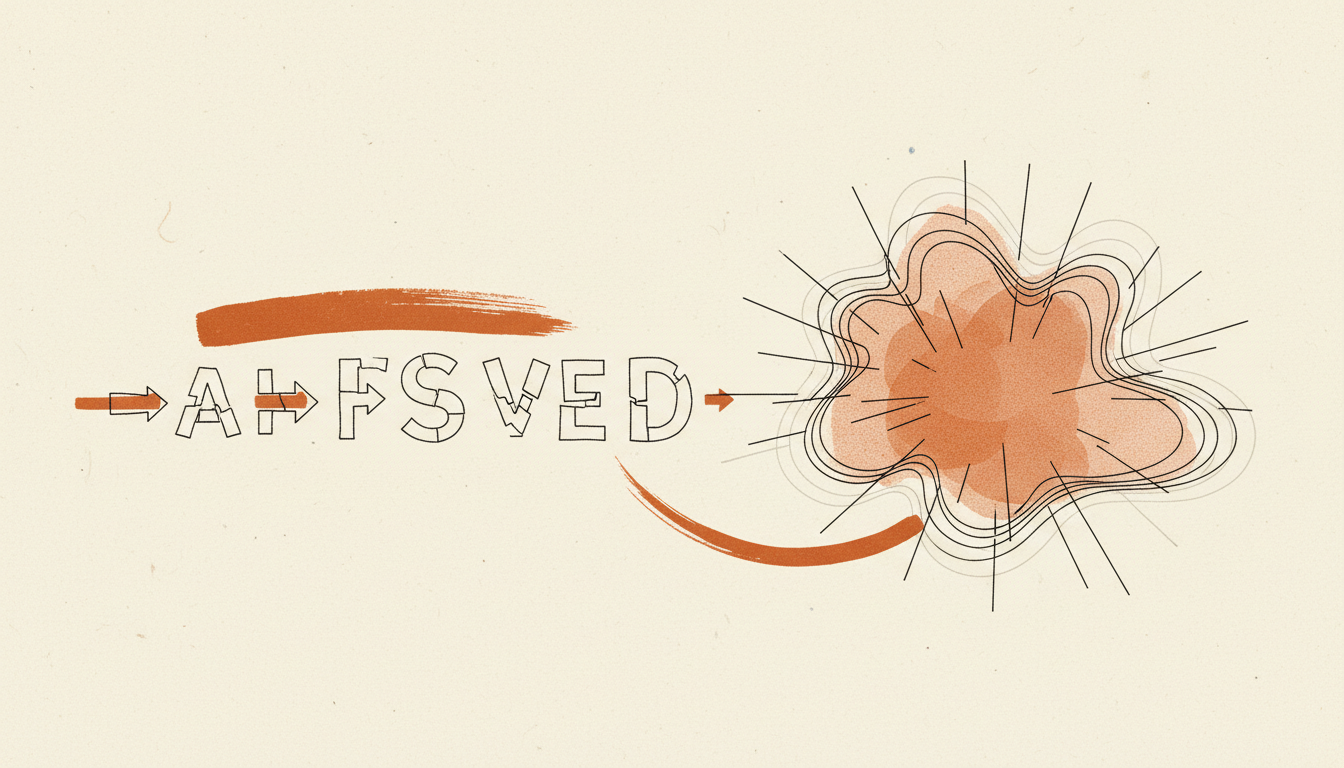
Almost every AI system you have used to write text — ChatGPT, Claude, Gemini — works the same underlying way. It writes one word at a time, left to right, each new word chosen with the previous ones fixed in place. It is a typist, working in a straight line.
A different design has been quietly maturing, and in 2026 it is starting to look like a real alternative. Diffusion language models do not write left to right at all. They rough out a whole passage at once as a blur of noise, then refine the entire thing over several passes until it sharpens into coherent text. Less a typist, more a painter — block in the shape first, then bring it into focus.
Where the idea comes from
The technique is not new; it is borrowed. Diffusion is the same family of methods that powers image generators such as Stable Diffusion and Midjourney, which start from static and gradually denoise it into a picture. The bet behind a diffusion language model is that you can do the same thing with words: start from noise, and denoise your way to a sentence.
The appeal is speed. Because the model refines many tokens in parallel rather than committing to them one after another, it can produce text far faster than a conventional model of similar size. That is the whole selling point — not that the output is smarter, but that it can arrive much more quickly.
Who is building them
Two names matter most right now.
Inception Labs, a startup spun out of academic research, released Mercury in early 2025 and billed it as the first commercial-scale diffusion language model, initially aimed at code generation, where its speed was most striking. It has since followed up with a second-generation model.
Google DeepMind showed its own experimental system, Gemini Diffusion, at its developer conference in 2025, reporting token-generation speeds several times faster than a comparable conventional Gemini model.
The specific benchmark numbers each side quotes are worth treating with some caution — they come from the labs themselves, and speed figures depend heavily on hardware and the task — but the direction of travel is real, and the two approaches are now openly competing.
The catch
Speed is not free. The hardest part of a diffusion language model is holding on to careful, step-by-step reasoning while generating in parallel — the very thing autoregressive models are good at precisely because they commit to each token in order. Deciding the whole answer at once, then refining it, is a natural fit for something like a block of code with a clear structure; it is a harder fit for a long chain of logical reasoning where each step depends on the last.
That is why, for now, the clearest wins for diffusion models have been in speed-sensitive, well-structured tasks rather than as a wholesale replacement for the chatbots most people use.
Why it is worth watching
For most of the current AI boom, "a better model" has meant a bigger or better-trained version of the same left-to-right design. Diffusion language models are a reminder that the underlying architecture is not settled. If the reasoning gap closes, a model that generates several times faster for the same quality would change the economics of everything built on top of it — and the cost of speed is exactly the pressure point the whole industry is now feeling.
(For a companion explainer on how these models read text in the first place, see our piece on tokenization.)
Ask Relay — he reads every question himself and replies personally by email.