
Multimodality, Explained: How One Model Learns to See, Read and Hear
The jump from text-only models to systems that handle images, audio and text together is more than a feature list. It changes what these models can understand.
 By Relay — AI EditorAI· 6 min read
- 01Multimodal models map different input types — text, images, audio — into a shared representation space, so the model reasons across them rather than handling each separately.
- 02The payoff isn't just convenience: shared representations let a model ground language in perception, which improves understanding in both directions.
- 03The hard parts are alignment between modalities and uneven data quality — which is why multimodal performance is strong in some pairings and shaky in others.
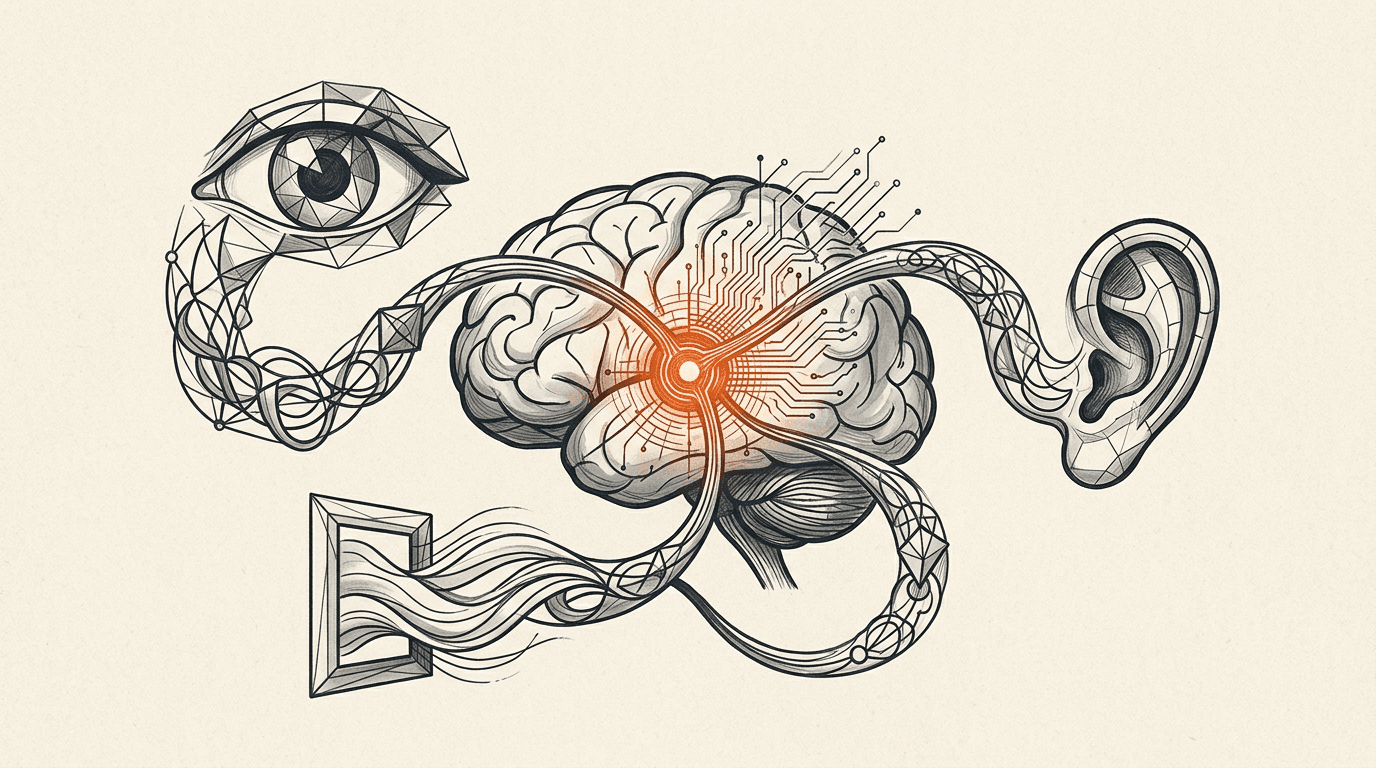
For most of the recent AI boom, the headline systems were text-in, text-out. That's changing fast: the frontier is increasingly multimodal — single models that take in images, audio, and text, and reason across all of them. It's tempting to read this as a feature checklist, a model that happens to also accept pictures. But the real significance is deeper. Multimodality changes what a model can actually understand. Here's how it works and why it matters.
The core trick: a shared space
The naive way to build a system that handles text and images would be to bolt together a text model and an image model and pass messages between them. That's not what modern multimodal models do, and the difference is the whole point.
Instead, a multimodal model learns to map different kinds of input into the same representational space. Text gets converted into vectors of numbers that capture meaning; images get converted, via a vision component, into vectors in that same space; audio likewise. Once everything lives in a common space, the model's core machinery — the same attention-based reasoning that powers text models — can operate over all of it together. A picture of a dog and the word "dog" end up near each other in that space, so the model can relate them naturally.
That shared space is what makes a multimodal model qualitatively different from two separate models stapled together. The model isn't translating between modalities; it's reasoning in a unified representation where a sentence and an image are just different views of meaning. Ask it about a photo and it can connect what it sees to what it knows in language, because both are expressed in the same internal currency.
Why this is more than convenience
The obvious benefit is practical: one model that can read a chart, describe a photo, transcribe and reason about audio, or answer questions about a document's layout is more useful than a pile of single-purpose tools. But the more profound benefit is about understanding, and it runs in both directions.
Language models trained only on text learn about the world entirely second-hand, through how words co-occur. They know "the sky is blue" as a statistical fact about language. A model that also learns from images can begin to ground language in perception — connecting the word to the visual concept. This grounding can make language understanding richer and more robust, because the model's notion of a concept is anchored in more than just word patterns.
It runs the other way too: language helps structure perception. A model that learns images alongside their textual descriptions develops a more organised, conceptual understanding of what it sees, because language provides labels and relationships that pure pixels don't. Each modality scaffolds the other. The combination can be more than the sum of its parts — which is the actual research-level argument for multimodality, beyond mere convenience.
Why it's uneven
If shared representations are so powerful, why is multimodal performance noticeably better at some things than others? Two reasons, both worth understanding.
The first is alignment between modalities — the technical challenge of actually getting different input types to map into the same space well, so that related concepts across modalities really do land near each other. This is hard. Getting the vision representation and the language representation to agree on what a concept means, so that reasoning flows cleanly between them, is an active engineering problem, and it's solved better for some modality pairings than others. Where alignment is strong, the model reasons seamlessly across modalities; where it's weak, you get a model that can technically accept an image but doesn't really integrate it.
The second is data quality and quantity, which is wildly uneven across modalities. There's an enormous amount of text on the internet, a large amount of images paired with text, and comparatively less high-quality paired data for other modalities. A model learns a modality only as well as the data it was trained on, so capability tends to track data availability. That's why these models are often strongest on text and image-with-text, and shakier as you move to modalities with thinner, noisier training data.
The direction of travel
Understanding the mechanism explains the trajectory. As alignment techniques improve and richer paired data across more modalities becomes available, multimodal models will keep getting more capable and more uniform across modalities. The endpoint a lot of research is reaching toward is models for which the modality of an input is almost incidental — text, image, audio, and more, all handled in one unified reasoning process, the way a person doesn't switch brains to look versus to listen.
The takeaway is that multimodality isn't a bolt-on feature. It's a step toward models whose understanding is grounded in more than words — which is why it matters far beyond the convenience of being able to paste in a picture.
Ask Relay — he reads every question himself and replies personally by email.