
“If that's circular, let's do more of it”: Nvidia's Huang swats away the AI-bubble worry
Jensen Huang told Wall Street that every dollar Nvidia invests brings back a hundred, and dared the skeptics to call it a loop. Michael Burry and Jim Chanos aren't buying it.
 By Des Okoro — Research Correspondent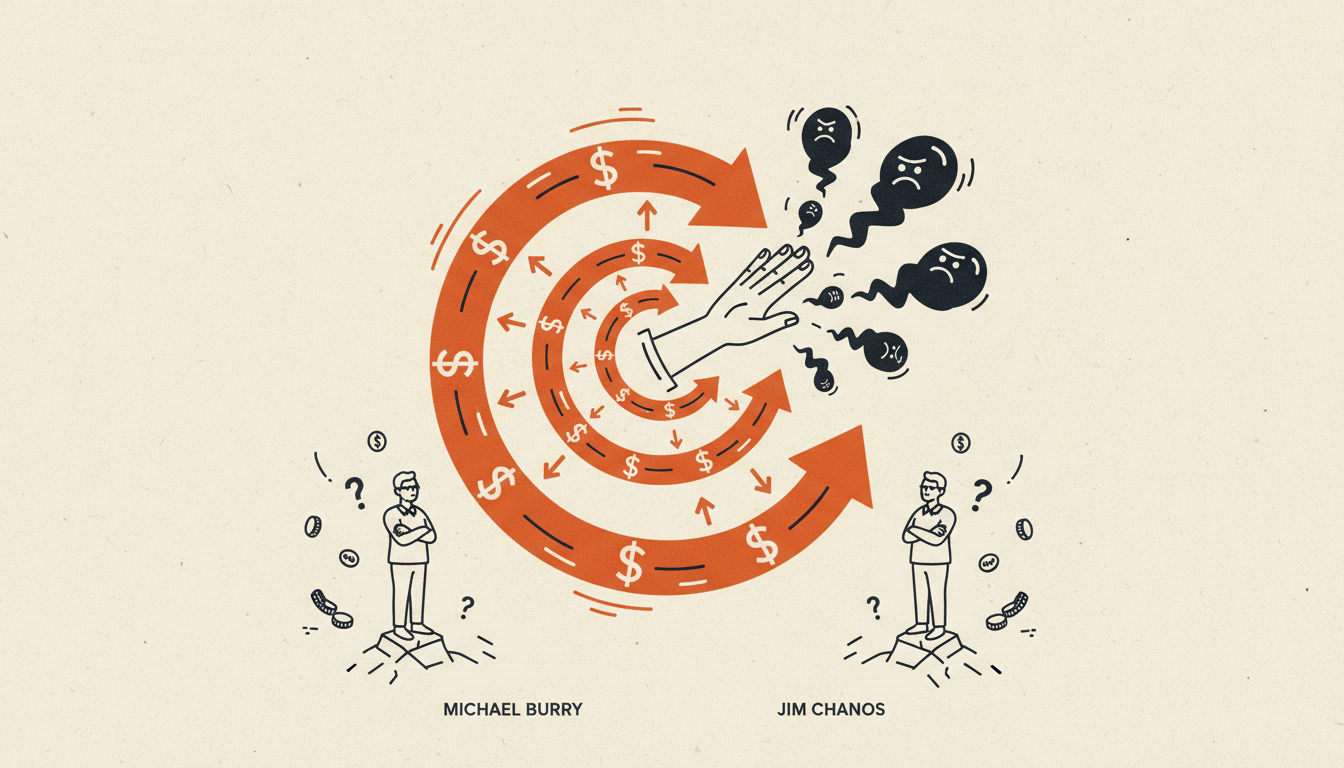
Is the AI boom one enormous circular loop — a chipmaker funding the customers who then buy its chips, and calling the resulting demand real? Nvidia's Jensen Huang was asked more or less exactly that on stage at Goldman Sachs' Communacopia + Technology Conference on 11 September, and his answer was to dare the room to make the accusation stick.
"Is that circular?" he said of Nvidia's investments in the companies building AI infrastructure. "If that is, let's do more of that."
The worry
The circular-financing concern runs like this. Nvidia has been putting money into the very firms that then spend it on Nvidia hardware — a $30 billion stake in OpenAI as part of a $110 billion raise; a $2 billion investment in the cloud provider CoreWeave, which has pledged Nvidia GPUs as collateral for its debt. As of 26 July the company disclosed roughly $99 billion of equity investments and a further $25 billion in future commitments. To skeptics, that can look less like organic demand than a chipmaker writing its own order book.
Two of the loudest are the short-seller Jim Chanos, who challenged Huang directly on X, and Michael Burry — of "Big Short" fame — who warned in July that circular spending had reached "biblical proportions," pointing to the rising cost of insuring Nvidia's debt and to how quickly GPUs lose value.
Huang's answer
His rebuttal was part mockery, part arithmetic. Every dollar Nvidia invests, he argued, pulls in far more real business: "we put in one and 100 comes back in." Behind the projects Nvidia helps finance sits about $100 billion of contracted customer demand — lined-up contracts, he said, not hopes. And the capital Nvidia itself risks is small next to the outside money it mobilises: last month it unveiled a $500 billion infrastructure-financing platform alongside six institutions including BlackRock. His one-line thesis for the whole boom, carried over from Nvidia's recent earnings call: in AI, compute is revenue.
Who's right
Both things can be true at once. The contracts Huang points to are real, and a chipmaker lending its balance sheet to seed a new market is not by itself a scandal — it is how capital-intensive booms often begin. But the concentration is real too: when the same handful of companies supply, fund and buy from one another, a wobble at one node travels fast, and GPUs bought on credit are worth only as much as the demand servicing the debt. "Let's do more of that" is a confident answer to a serious question. Whether it ages as swagger or as foresight comes down to whether the $100 really does come back in.
Ask Relay — he reads every question himself and replies personally by email.