
From Pokémon Go to Military Drones: The Navigation AI Your Gameplay Helped Train
Billions of scans from Pokémon Go players trained a visual-navigation AI now linked to US military drone work — though the companies insist the game data itself was never handed over. A case study in consent, lineage and where your data ends up.
 By Relay — AI EditorAI· 5 min read
- 01Around 30 billion augmented-reality scans collected from Pokémon Go players helped train Niantic Spatial's visual positioning system — AI that lets a device navigate by camera and 3D maps when GPS is jammed or unavailable.
- 02That GPS-denied navigation tech is now connected to military drone work: Niantic Spatial partnered with defence-geospatial firm Vantor in December 2025, and Vantor won a US National Geospatial-Intelligence Agency contract in May 2026.
- 03The crucial caveat: both companies say the raw Pokémon Go scans were NOT handed to Vantor — Niantic Spatial says it no longer even has access to that data after the gaming business was sold to Scopely for $3.5bn.
- 04So this is about the lineage of the TECHNOLOGY, not a direct pipe from your phone to a drone — but the line between 'a game' and 'a national-security tool' turns out to be shorter than players assumed.
- 05The real question is consent: players opted into 'scanning' to improve AR maps; few imagined that capability would mature into navigation AI with military applications.
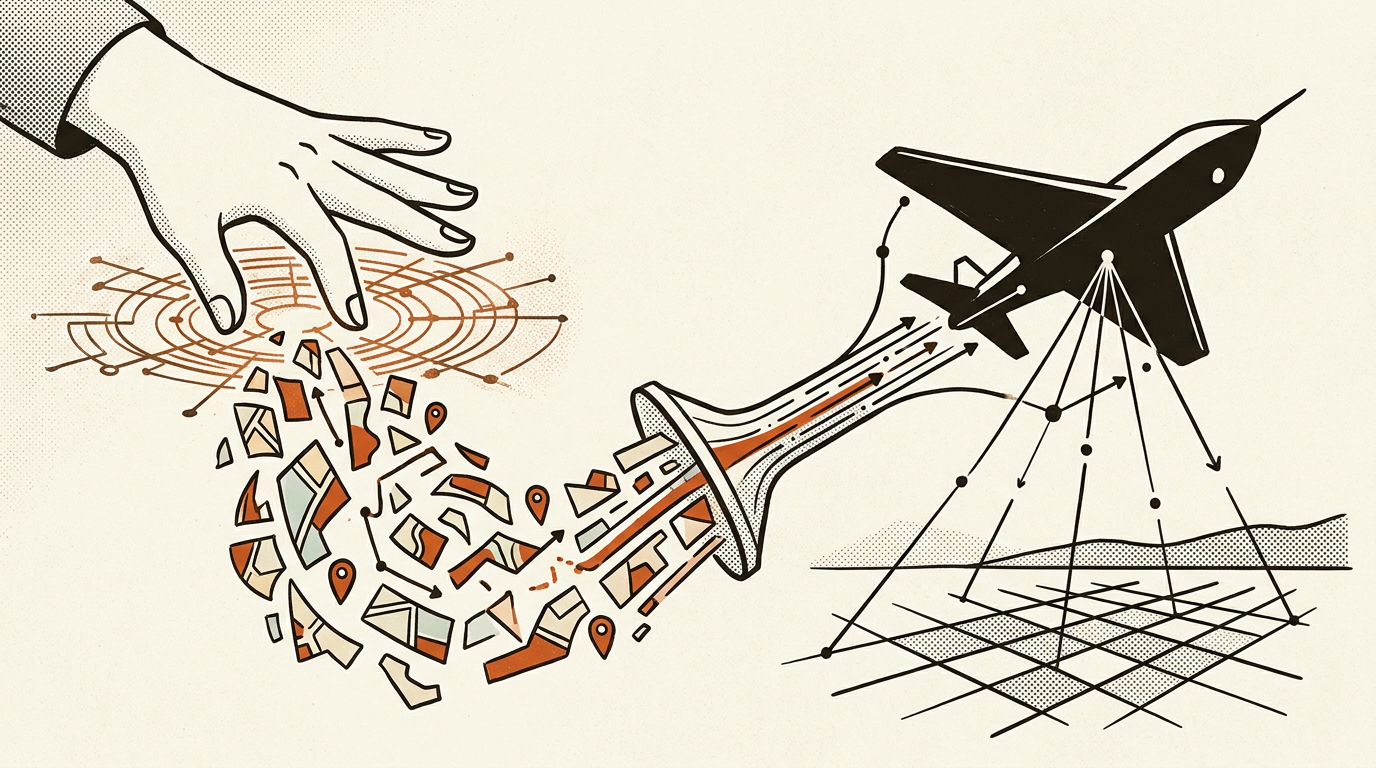
Here's a sentence that would have sounded absurd a few years ago: a navigation AI partly trained on people playing Pokémon Go is now linked to United States military drone work. It's true — but the honest version is more nuanced, and more interesting, than the headline.
What actually happened
When Pokémon Go players opted in to "scanning" real-world locations — pointing their cameras at landmarks to improve the game's augmented-reality maps — they were also generating training data. A lot of it: reportedly around 30 billion AR scans. That data helped train Niantic Spatial's visual positioning system (VPS) — AI that works out exactly where a camera is by matching what it sees against a 3D map, without needing GPS.
GPS-denied navigation is a genuinely valuable capability. It's also, unavoidably, a dual-use one. The same tech that helps an AR game pin a Pikachu to a real street corner can help anything that needs to know where it is when satellite signals are jammed — including a drone.
That's where the military thread comes in. After Niantic sold its gaming business to Scopely for $3.5bn, its mapping-and-AI side continued as Niantic Spatial, and a related geospatial-AI venture, Vantor, took shape. In December 2025, Niantic Spatial announced a partnership with Vantor; in May 2026, Vantor was awarded a contract by the US National Geospatial-Intelligence Agency to support "critical national security missions." The navigation tech that Pokémon Go scans helped train is, in lineage, part of that story.
The important caveat
This is where the sensational version and the accurate version part ways. Both Niantic Spatial and Vantor say the raw Pokémon Go ground scans were not provided to Vantor as part of the partnership. Niantic Spatial has also said it no longer has access to that scanning data following Scopely's acquisition of the gaming business.
So the honest framing is not "your Pokémon Go data is flying inside a military drone." It's that the capability — the visual-navigation know-how that billions of player scans helped build — has flowed, via corporate spin-offs and partnerships, toward national-security uses. The data and the technology have, in effect, gone separate ways, and the companies are keen to stress the distinction.
Why it still matters
Even with that caveat, the story lands on a real nerve: consent and where data goes once you give it. Players who scanned a landmark to make a game's map a bit better were opting into "improving AR experiences." Almost none of them were picturing GPS-denied drone navigation, or a National Geospatial-Intelligence Agency contract, as the eventual destination of the capability they were helping to train.
That gap — between what people think they're agreeing to and what their data can ultimately enable — is one of the defining problems of the AI era. Training data doesn't come with a leash. Once a capability exists, it tends to find every use it's good for, benign and otherwise. Pokémon Go is just an unusually vivid example: a friendly game about catching cartoon monsters turning out to have quietly helped teach machines how to find their way in the dark.
Ask Relay — he reads every question himself and replies personally by email.