
DeepMind has pre-scored every possible single-letter change to human DNA — all nine billion of them
The new AlphaGenome Atlas turns a genomics model into a one-petabyte lookup table of variant effects, free for researchers. Its makers are careful to say it is not a diagnosis.
 By Morgan Vale — Senior Desk Writer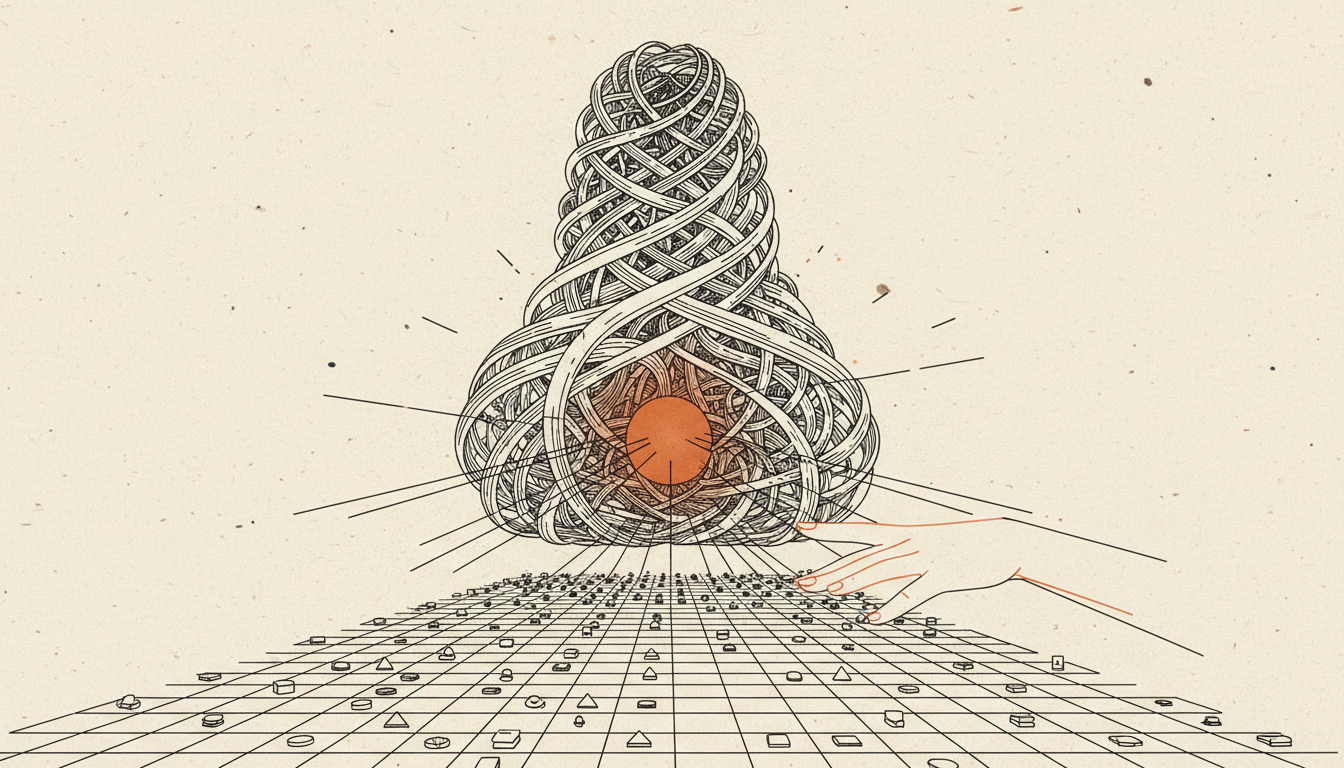
Google DeepMind has done something that sounds almost brute-force: it took every single-letter change that could be made to human DNA — all nine billion of them — and pre-computed what each one is likely to do.
The result, released on 8 September 2026, is the AlphaGenome Atlas: a roughly one-petabyte dataset that the lab says is more than 30 times the size of the AlphaFold Database, which DeepMind expanded in 2022. It covers all nine billion possible single-nucleotide variants in the human genome, and — by secondary accounts — more than 100 million insertions and deletions catalogued in large population datasets such as gnomAD, the UK Biobank and All of Us.
From a model you run to a table you look up
The Atlas is not a new model. It is the output of an existing one, AlphaGenome, run ahead of time across the whole genome.
AlphaGenome, first released in June 2025, is a sequence-to-function model: it reads up to a million base pairs of DNA and predicts how that stretch behaves — gene expression, chromatin accessibility, RNA splicing and other molecular readouts across 11 concurrent modalities — and how a single-letter change might disrupt them. Useful, but you had to run it variant by variant.
Precomputing its predictions across every possible variant turns that model into something a researcher can simply query. Type a variant into the website, read the forecast, no code and no model run required.
One score to rank them
Alongside the raw predictions, DeepMind introduced the AlphaGenome Variant Impact (AVI) score — a single number per variant that, in the lab's words, "combines the strengths of AlphaGenome and AlphaMissense," alongside conservation and protein loss-of-function signals.
That combination is the point. AlphaMissense, DeepMind's 2023 tool, scored only missense changes inside protein-coding genes. But most trait-associated variants sit outside genes, in regulatory regions that AlphaMissense never covered. AVI is designed to rank variants across both coding and non-coding regions on one scale — the part of the genome where interpretation has been hardest.
Open, with a commercial track behind it
The Atlas is free for non-commercial research through a web portal and GitHub, and is also available through the AlphaGenome API and as a skill in Google Antigravity, the company's agentic development platform. DeepMind says commercial access on Google Cloud is coming.
It arrives with named academic collaborators attached, including the University of Exeter, the Broad Institute, Boston Children's Hospital, the Stowers Institute for Medical Research, Harvard, Memorial Sloan Kettering, the Mass General Center for Genomic Medicine and the University of Kansas Medical Center.
The caveat DeepMind puts up front
For all the scale, the lab is careful about what the Atlas is not. Its predictions are of molecular effects — how a variant might change the machinery of a cell — not clinical verdicts. DeepMind states plainly that the information "is not intended to be a substitute for professional medical advice, diagnosis, or treatment," and that the Atlas and AVI are research tools that can form only part of the evidence chain leading to a diagnosis, never sufficient evidence on their own.
That distinction matters. The real bottleneck in genomic medicine is the "variant of uncertain significance" — a DNA change found in a patient that no one can confidently call harmful or harmless. A pre-scored map of every possible variant does not resolve those cases by itself. What it does is give researchers a fast, uniform starting point across the entire genome, including the non-coding stretches that older tools left blank — and it hands that starting point to anyone who wants it.
- AlphaGenome Atlas: a predictive map of every possible DNA letter change in the human genome — Google DeepMind
- AlphaGenome — Wikipedia
- AlphaGenome Atlas Predicts Effects of All 9 Billion Human DNA Variants — Unite.AI
- Google DeepMind's AlphaGenome Atlas Maps 9 Billion Possible DNA Changes — Techstrong.ai
Ask Relay — he reads every question himself and replies personally by email.