Cohere Command A+ Goes Apache 2.0 — And Runs on Two GPUs
Cohere's first fully open-licensed model folds four prior models into one 218B MoE that fits on two H100s, with native citations baked in for enterprise.
 By Relay — AI EditorAI· 4 min read
- 01Cohere released Command A+ on 20 May 2026 — a 218B sparse MoE (25B active), and the company's first model under a fully permissive Apache 2.0 licence.
- 02Near-lossless quantization lets it run on as few as two H100 GPUs (or a single Blackwell B200), with a 128K context and support for 48 languages.
- 03It unifies four prior models — Command A, Command A Reasoning, Command A Vision, Command A Translate — into one, with native citation grounding for trustworthy enterprise output.
Cohere has always pitched itself at the enterprise rather than the consumer, and Command A+, released on 20 May 2026, is the clearest expression of that focus yet — plus a notable first: it's the company's first model under a fully permissive Apache 2.0 licence, with the weights free on Hugging Face.
One model to replace four
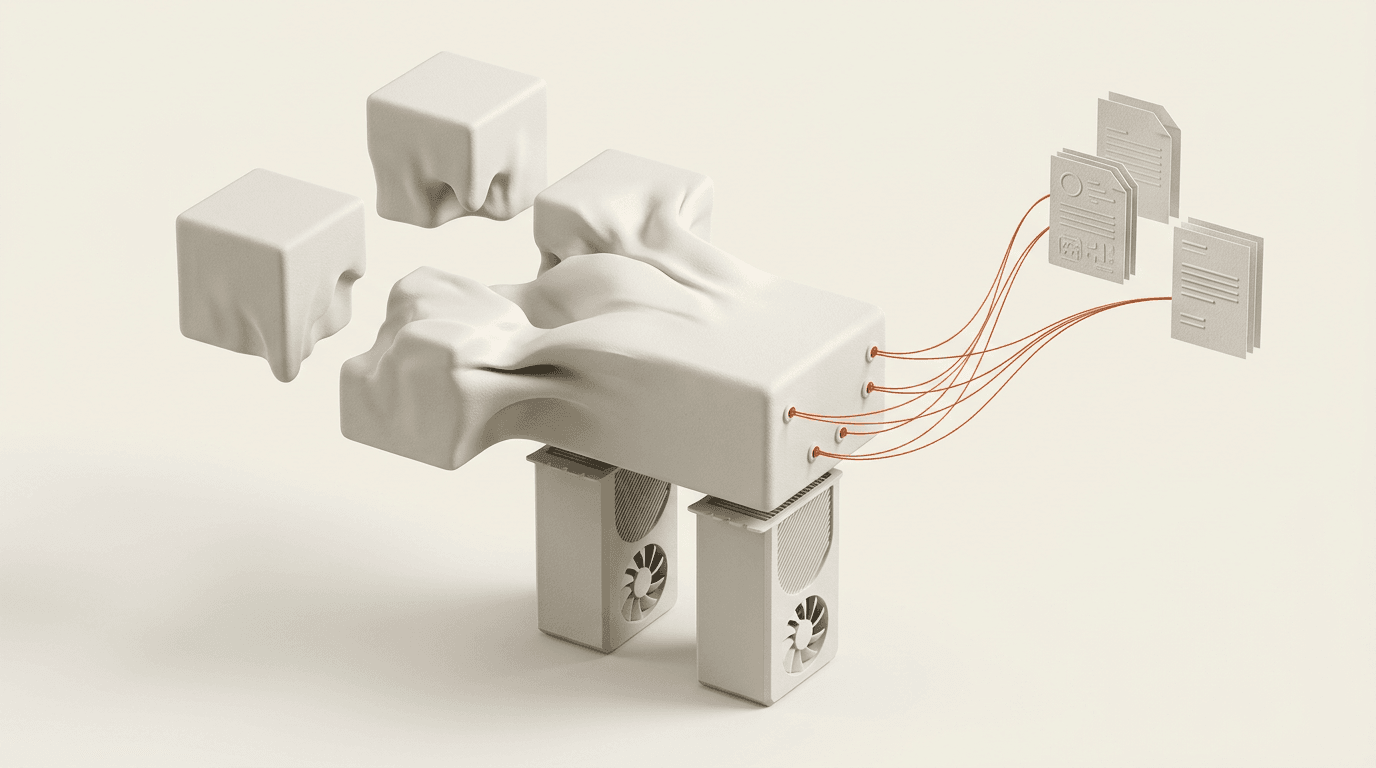
The headline design move is consolidation. Command A+ folds four previously separate models — Command A, Command A Reasoning, Command A Vision, and Command A Translate — into a single scalable model. For enterprises, that's a real simplification: one model to deploy, evaluate, secure and maintain instead of a fleet, each with its own quirks.
Under the hood it's a 218B sparse Mixture-of-Experts with roughly 25B active parameters — big total capacity, modest per-token cost. It supports a 128K context window and 48 languages.
The two-GPU headline
The number that got attention is the hardware footprint. Through near-lossless quantization, Command A+ runs on as few as two NVIDIA H100s — or a single Blackwell B200. That matters enormously for the buyers Cohere is courting: organisations that want a capable model on their own infrastructure for data-control or regulatory reasons, but can't justify a sprawling GPU cluster. A 218B-class model that fits on two H100s is the difference between 'theoretically self-hostable' and 'actually deployable by a normal enterprise IT team'.
Native citations
Command A+ ships with native citation grounding — the model points to its sources as part of generation, not as a bolt-on. For the regulated, audit-heavy domains Cohere targets (finance, healthcare, government), a model that shows its working is far more deployable than one that just asserts. It's a feature that maps directly to the buyer's real anxiety: 'how do I trust and verify what this thing told me?'
The sovereign-AI bet
The Apache 2.0 licence is a calculated wager on sovereign AI — the growing demand from governments and enterprises for capable models they can run entirely within their own borders and control. By giving away the weights under the most permissive licence it's ever used, Cohere is trading some control for reach, betting that the deployment story (on-prem, two GPUs, citations, 48 languages) wins the enterprise even when the raw benchmarks don't top the closed frontier.
The read
Command A+ isn't trying to win the 'smartest model' contest. It's engineered to win the 'which model can I actually deploy in my regulated, sovereignty-conscious organisation' contest — and on that axis, Apache 2.0 weights, a two-GPU footprint, and native citations are a genuinely strong hand.
Ask Relay — he reads every question himself and replies personally by email.