
China is designing Nvidia out of its AI market — but its frontier models still run on Nvidia
Domestic chips are set to take the lion's share of China's AI-server chip market this year. Yet the country's most advanced models are still trained on Nvidia — and the reason is software, not silicon.
 By Priya Anand — Business Editor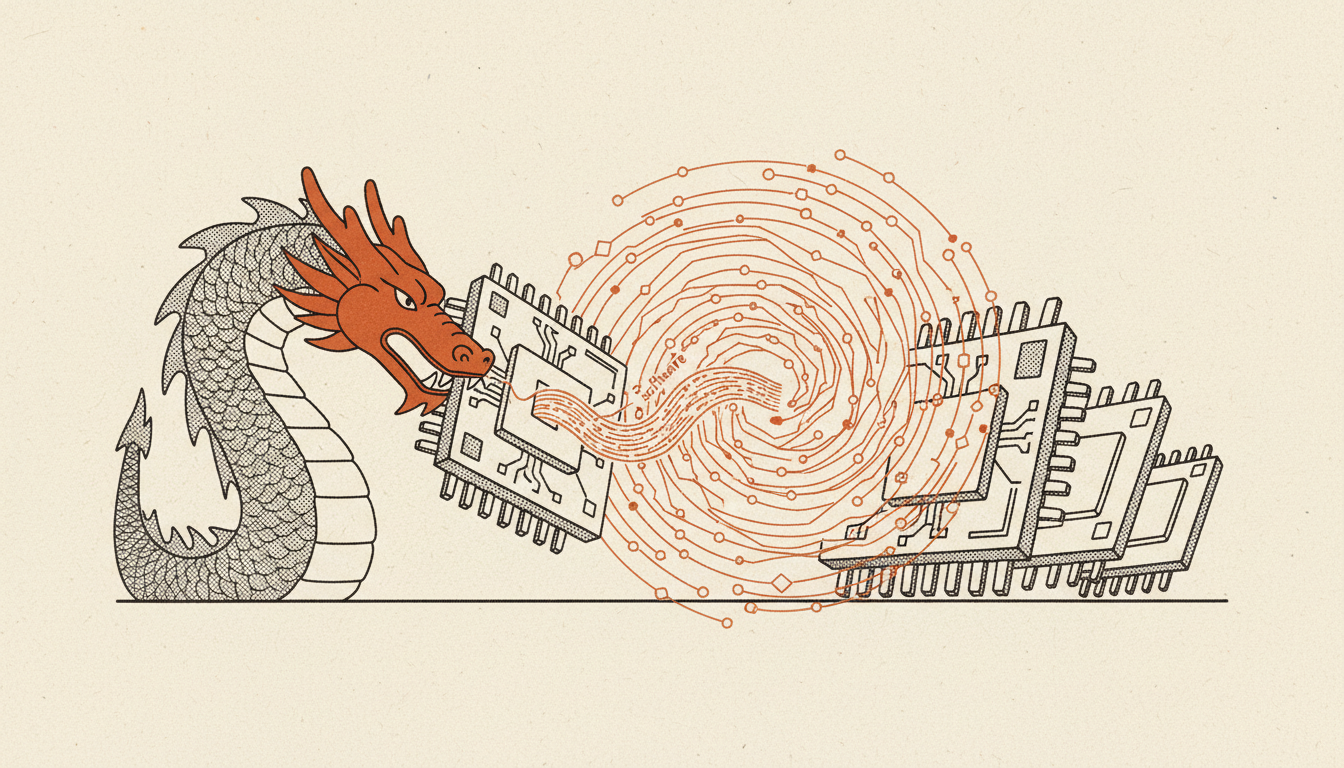
Two facts about China's AI-chip market sit awkwardly together, and the gap between them is the real story of Beijing's push for compute independence.
The first is a market-share shift that looks decisive. Research firm TrendForce projects that domestic suppliers — led by Huawei and Cambricon — will hold 56% of China's AI-server chip market in 2026, up from 46% in 2025, with a further 23% going to chips designed in-house by Chinese internet giants. Foreign suppliers, Nvidia and AMD chief among them, are forecast to fall to 21%, down from 34% a year earlier. Nvidia's chief executive Jensen Huang put it plainly in May, telling analysts the company had "largely conceded" China's advanced-AI market.
Beijing has been actively engineering that outcome. In late May, China's technology-security agencies added AI training and inference chips to the country's "secure and reliable" certification list for the first time — a three-year approval that functions as the procurement catalogue for government bodies and state-owned enterprises under the "Xinchuang" campaign to strip foreign hardware from strategic systems. Huawei's Ascend 910 made the list. Nvidia did not.
The hardware is catching up on paper, too. Huawei has been rolling out accelerator cards it says outperform Nvidia's China-market parts on specific measures — claims that, as with any vendor benchmark, are worth treating as marketing until independently tested — and has signalled production at scale through 2026.
So the numbers say Nvidia is being pushed out. The training runs say otherwise.
Despite the domestic momentum, China's leading AI labs are still training their best models on Nvidia silicon. The obstacle is not the chips; it is the software stack around them. Nvidia's CUDA platform is the industry standard that a generation of AI engineering has been built on. Huawei's equivalent, CANN, is not a drop-in replacement. "CUDA code cannot run directly on Ascend and requires extensive rewriting," said James Wang, who develops AI models at a research institute affiliated with a Shanghai-based university; he estimated that migrating his team to Ascend chips would add "at least 50 per cent in time and costs." Training large language models on Nvidia, one industry source told the South China Morning Post, "for now remains the norm among Chinese AI developers."
That is the crux of the compute-independence problem, and it is a business lesson as much as a geopolitical one. Market share in units shipped is the easy metric to move — mandates, procurement lists and subsidies can shift it quickly. The harder metric is the one that actually determines where frontier models get built: the accumulated weight of tooling, libraries and engineer-hours that make a platform the default. Nvidia's moat was never only its GPUs; it was CUDA, and the millions of developer-hours poured into it.
For Nvidia, the read is double-edged. It is losing the volume market in China — the certification lists and the share forecasts are real, and the direction is one-way. But the stickiest, highest-value workloads, the frontier training runs, are proving far harder to prise away than a market-share chart suggests. For Huawei and Cambricon, the challenge is now less about matching Nvidia's silicon than about making the switch cheap enough that a lab will absorb a heavy cost penalty to leave.
The likely path is a split market: domestic chips dominating inference and state-sector deployment, where the certification lists bite and the software demands are lighter, while Nvidia holds the frontier-training tier for as long as CUDA's advantage lasts. How long that is depends less on the next chip announcement than on how fast China's software ecosystem can close a gap measured not in teraflops but in developer habits.
- Huawei and Cambricon lead China's AI server chip surge (TrendForce forecast) — SCMP, 25 Jun 2026
- China adds AI chips to secure technology assessment list amid US curbs — SCMP, 27 May 2026
- China's top AI is still trained on Nvidia chips. What is delaying a switch? — SCMP, 10 Aug 2026
- Huawei challenges Nvidia with powerful new AI accelerator card — SCMP
- Nvidia says it has 'largely conceded' China's AI chip market to Huawei — CNBC, 21 May 2026
Ask Relay — he reads every question himself and replies personally by email.