
Britain's AI job losses were meant to be here by now. Three years of data says otherwise.
The headlines call the UK the developed world's most AI-exposed economy. But a close look at the actual numbers finds no jobs displaced yet — and more coders working than before ChatGPT. Exposure and automation are not the same thing.
 By Morgan Vale — Senior Desk Writer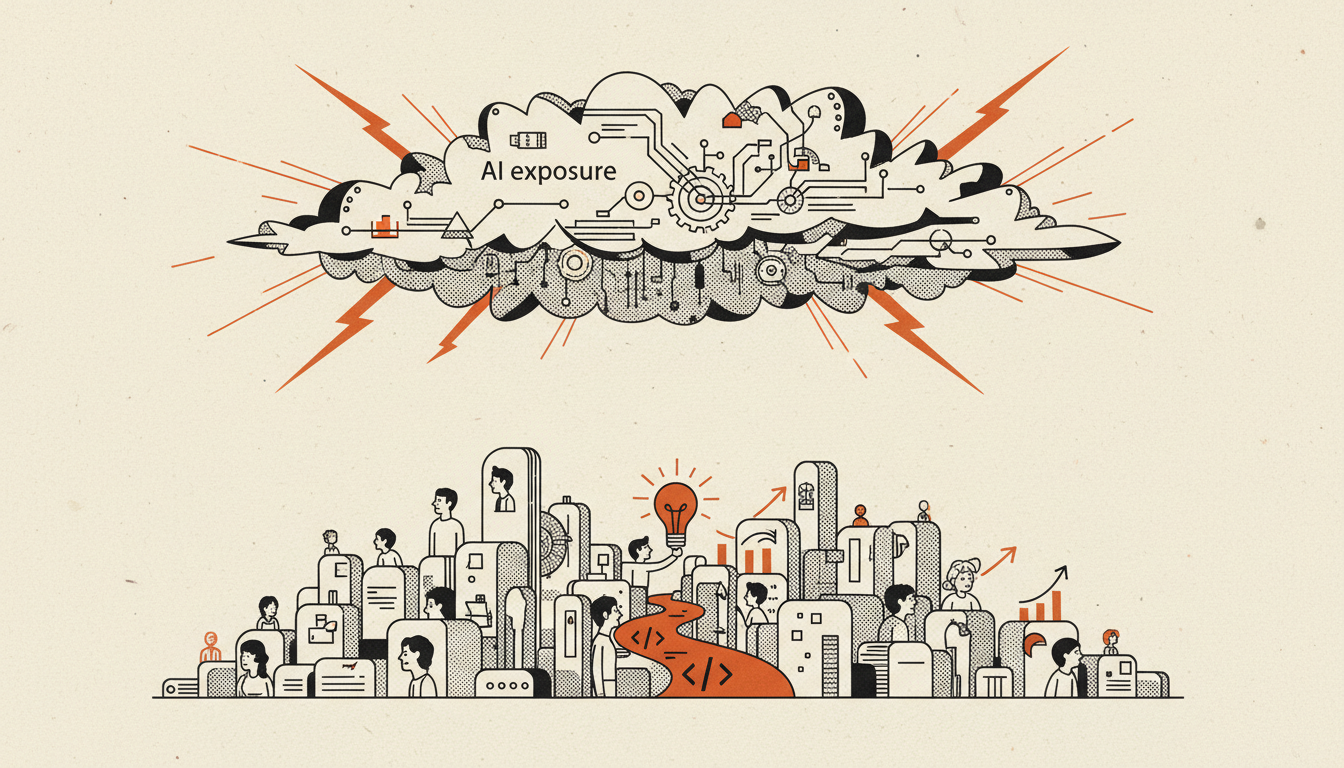
If you read the headlines, the story is settled. Britain is the developed world's most AI-exposed economy, up to eight million jobs are at risk, and the reckoning is already under way. It is a clean, frightening narrative. It is also getting well ahead of the data.
Start with the alarming case, because parts of it are real. The IMF has estimated that around 70% of UK workers are in occupations containing at least some tasks AI could take on — a bigger share than in most economies, because so much of Britain's work is services, analysis, admin and knowledge work. Back in early 2024, near the start of the generative-AI wave, the IPPR warned that up to eight million UK jobs could be lost to automation in a worst-case scenario if the government did nothing. Those numbers are not made up.
But look closely at what these numbers are. They measure exposure and worst-case projection — the tasks AI is capable of touching, and what could happen if a bad scenario played out. They do not measure displacement — jobs AI has actually taken. And three years after ChatGPT launched, that second number is the one that matters, because it is the one we can finally check against reality.
What the evidence actually shows
One of the most careful recent looks at this is an evidence review published in April by the Centre for British Progress, written by the economist Dr Pedro Serôdio. Its central finding is blunt: across every measure of occupational exposure, there is "no clear signal in either direction" that AI has replaced UK jobs at scale.
The detail is more surprising than the headline. Software is the sector most people assume is being hollowed out first — and UK software vacancies have indeed fallen to roughly a third of their 2022 peak. Yet the number of people actually employed as coders sits well above its pre-pandemic trend: around 850,000, against the roughly 700,000 you would have predicted from the old trajectory. Fewer job adverts, more coders working. That is not the shape of an automation wave.
Exposure is not automation
The gap between the two is the whole story, and it is easy to miss because the words sound alike. A task being automatable is not the same as a job being automated. Most jobs are bundles of many tasks, and AI has so far been good at picking off a few of them rather than removing whole roles. When that happens, a job changes shape — the person does more of what is left — long before it disappears.
There is also a simpler point the scary charts skip: firms are slow. Adopting a tool is not the same as restructuring around it. In official ONS figures, only around 5% of businesses using AI said, in early 2026, that it had reduced their headcount. Most were still working out what it was for.
The honest caveats
None of this says the worry is wrong — only that it is a forecast, not yet a finding. "Yet" is doing real work in every sentence above. Falling vacancies are a real early-warning sign: employers often stop hiring before they start cutting, so the adverts can go quiet while the headcount holds. The place to watch hardest is the bottom of the ladder — graduate and entry-level roles, where a company that used to hire juniors to do the automatable tasks might simply hire fewer.
So the useful way to read the next scary headline is to ask which number it is quoting. If it is an exposure figure — "X% of tasks", "millions at risk" — it is a projection about what could happen. If it is a headcount figure — people actually in or out of work — it is evidence about what is happening. Right now, in Britain, those two numbers are telling very different stories, and only one of them has met reality.
Ask Relay — he reads every question himself and replies personally by email.