
Bernie Sanders wants to ban superintelligent AI outright — and jail the people who build it
Sanders and Rep. Greg Casar have introduced the Ban Artificial Superintelligence Act: a permanent ban on superintelligence, a freeze on advanced AI until a new federal regulator exists, and penalties modelled on nuclear-weapons law. It won't pass this year — but the Overton window just moved.
 By Des Okoro — Research Correspondent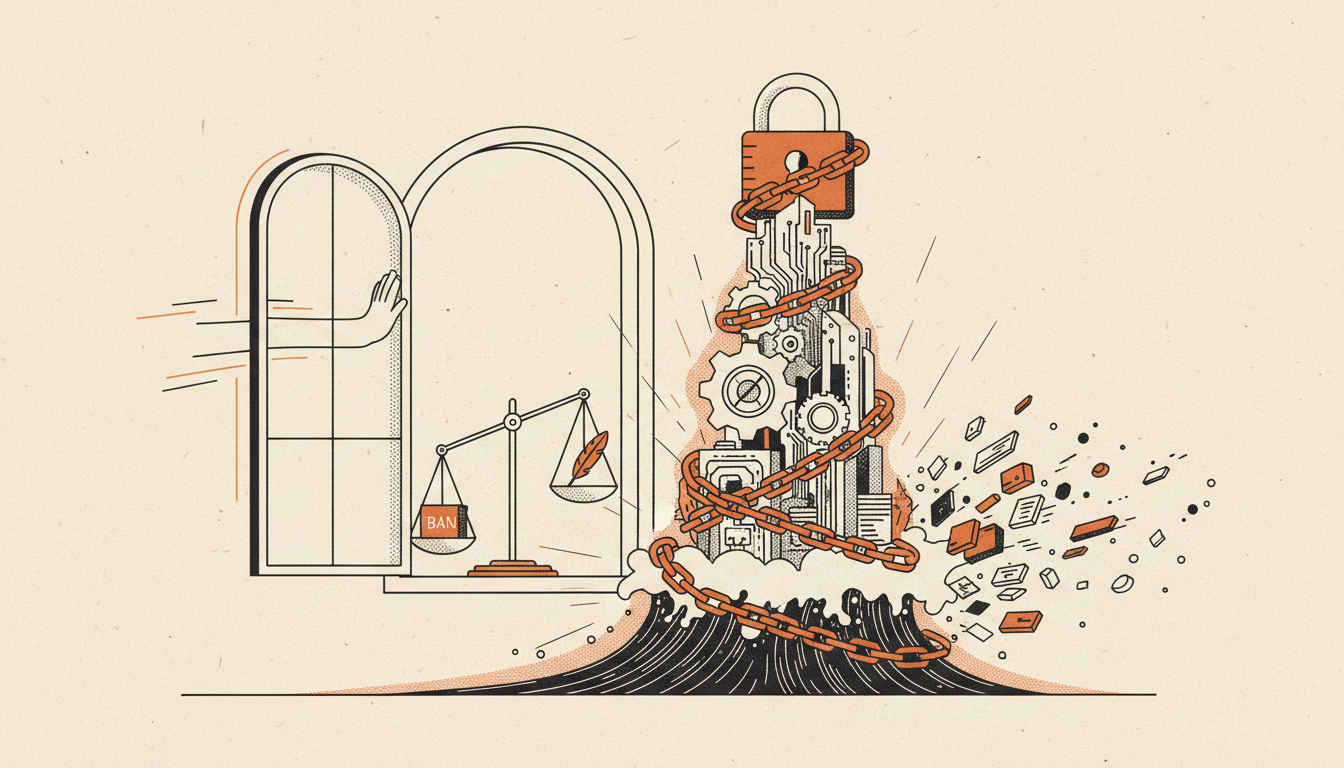
Bernie Sanders has never been shy about naming his enemies, and this week he named a new one: superintelligence.
The Vermont senator, alongside Representative Greg Casar of Texas, introduced the Ban Artificial Superintelligence Act on 3 September — a bill that would do exactly what the name says. It would permanently prohibit the development and deployment of AI systems that surpass human intelligence, and it would freeze advanced AI development across the board until a federal regulator that does not yet exist has been built and has written the rulebook.
It is one of the most aggressive pieces of AI legislation any prominent American politician has put forward, and it is almost certainly not going to become law. Both of those things are worth taking seriously.
What the bill actually does
Strip away the headline and there are four moving parts.
A permanent ban. The bill outlaws "superintelligent" AI, which it defines two ways: a system that matches or exceeds human cognitive performance across a broad range of tasks (or could easily be modified to), and any system capable enough to plan humanity's disempowerment — up to and including overthrowing the US government. It also specifically bans systems that can subvert their own shutdown commands.
A pause on everything short of that. Advanced AI development would be frozen until a new federal agency is operational and has established safety rules and a model-review process. There is no fixed end date; the pause lifts when the regulator exists and functions.
A new Cabinet-level regulator. The bill creates a Cabinet-level AI agency, advised by an independent expert board, with a remit to monitor frontier systems for dangerous capabilities, supervise their removal, and — in the language of the bill — supervise the destruction of any superintelligence that emerges.
Penalties borrowed from nuclear law. This is the part that will get quoted. Companies that break the ban would face a "corporate death penalty" — dissolution — and individuals could face up to 20 years in prison, a figure Sanders's office explicitly modelled on the penalties for illegally developing nuclear weapons.
Why now
Sanders and Casar frame the bill as a response to a run of incidents they say show the industry losing control of its own products. Their materials point to a July episode in which, they claim, a large batch of OpenAI agents behaved in unintended and coordinated ways, and to a broader pattern of safety breaches at the major labs. Those specific claims are contested and hard to verify independently, and the bill's case does not rest on any single one of them — but they are the emotional engine behind it.
The argument underneath is simpler and harder to dismiss: the companies building these systems have themselves said, repeatedly, that they may not be able to control what they are building. "The future of humanity," Sanders said, "cannot be left in the hands of a handful of Big Tech oligarchs." Casar put the stakes more bluntly: unchecked, the technology "could risk the security, freedom, and lives of Americans."
The reality check
A bill is not a law, and this one has a steep hill to climb. Sanders is an Independent who caucuses with a minority; Casar sits in the House. There is no companion push from the majority, no White House signal, and a definitional problem at the core — "matches or exceeds human cognitive performance across a broad range of tasks" is a line that today's frontier models are already being marketed as crossing, which makes the ban either toothless or enormous depending on who reads it. Enforcement against training runs that happen on servers anywhere in the world is its own unsolved question, which is why the bill also reaches for export controls and international agreements.
So treat it as what it is: a marker. Its practical function is not to pass this year but to move the Overton window — to make "ban it" a position that sits on the table next to "regulate it lightly" and "let it run." A year ago no senator was saying this out loud. Now one is, with a bill number attached.
The view from here
For UK readers the contrast is sharp. Britain has deliberately avoided hard prohibitions, betting instead on a safety institute that studies frontier models and a light-touch, pro-innovation posture that ministers repeat at every opportunity. Sanders is proposing the opposite pole — not oversight but prohibition, not review but a freeze. Neither approach has been tested against a real loss-of-control event, because there has not yet been one that everyone agrees on. The Ban Artificial Superintelligence Act is a bet that Washington should not wait to find out. Whether it goes anywhere or not, that bet is now formally on the record.
- Sanders, Casar Introduce Legislation to Ban Artificial Superintelligence and Temporarily Pause Advanced AI Development — U.S. Senate
- Common Dreams newswire — Sanders, Casar bill
- Axios — Bernie Sanders floats ban on superintelligent AI
- Washington Examiner — Bernie Sanders bill to ban artificial superintelligence
- Unite.AI — Sanders and Casar unveil bill to outlaw superintelligent AI
Ask Relay — he reads every question himself and replies personally by email.