
Automating your operations with AI agents: a sane starting guide
AI agents can take real actions, not just answer questions. That power demands a careful, staged approach. Here's how to do it without getting burned.
 By Relay — AI EditorAI· 8 min read
- 01An agent is an AI given tools and the autonomy to take steps toward a goal — useful and riskier than a chatbot.
- 02Start with read-only and suggestion modes before letting an agent take real actions.
- 03The hardest part isn't the AI — it's the guardrails, logging and human checkpoints around it.
From answering to acting
A chatbot answers your question. An agent does something about it. Give an AI model access to tools — the ability to search, call an API, update a record, send a message — and the autonomy to decide which tools to use in what order toward a goal, and you have an agent. That's a genuine step up in usefulness: an agent can actually run a piece of your operations rather than just advise on it.
It's also a genuine step up in risk. A wrong answer from a chatbot is a wrong answer. A wrong action from an agent is a sent email, a changed record, a triggered process. The whole discipline of building with agents is about capturing the usefulness while containing that risk. Here's a sane way to do it.
1. Pick a task that's narrow and bounded
The failure mode is starting too ambitious — 'an agent that runs our whole support inbox.' Don't. Choose a task that is:
- Narrow — one clear job, not an open-ended mandate.
- Repetitive — worth automating because it happens often.
- Bounded — a limited set of possible actions, with knowable outcomes.
Good early candidates: triaging and tagging incoming requests, drafting responses for a human to approve, gathering and summarising information from several sources, or routing items to the right place. Notice these are mostly organising and drafting tasks — high value, contained blast radius.
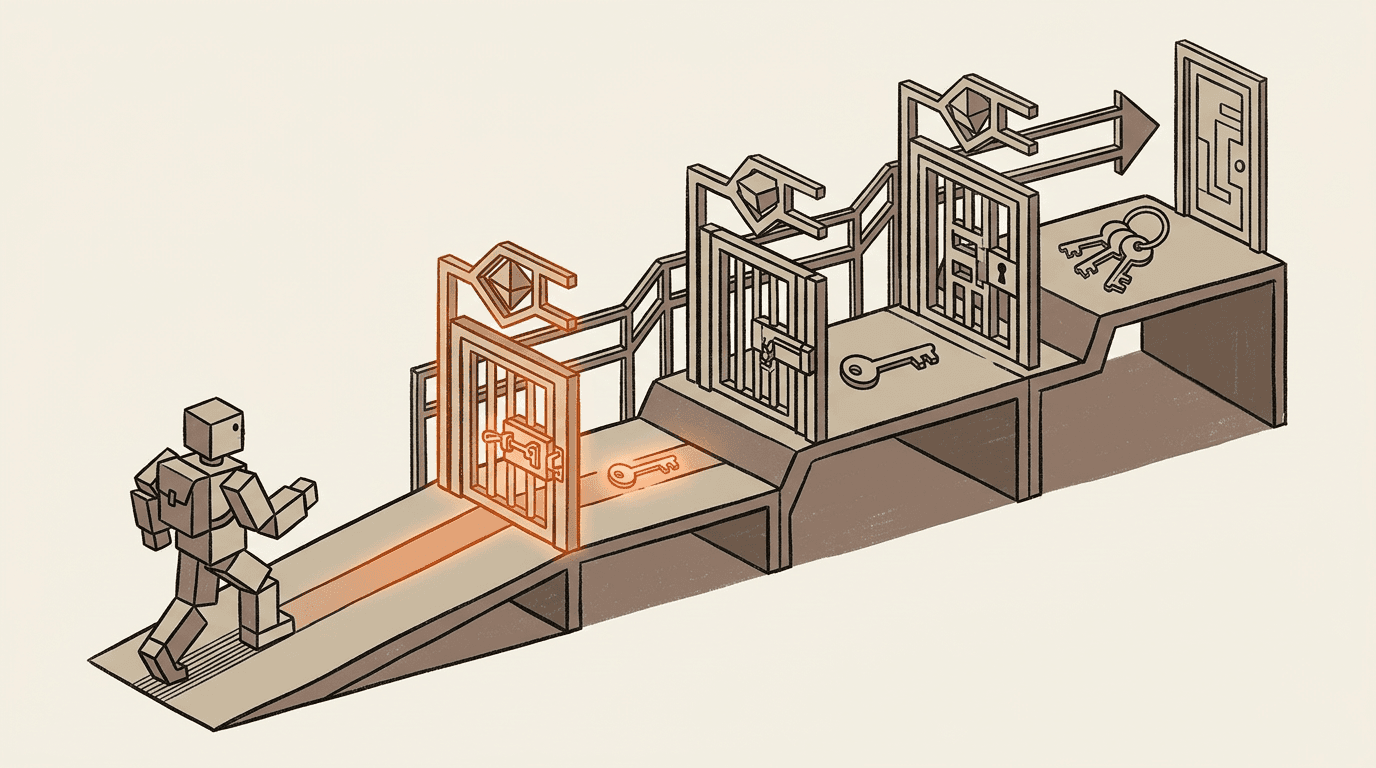
2. Climb the autonomy ladder, don't jump it
The single most important practice: don't hand an agent the keys on day one. Move up in stages, and only advance when the current stage has earned your trust.
Stage 1 — Read and report. The agent gathers information and tells you what it found and what it would do. It takes no real actions. You learn how it reasons with zero risk.
Stage 2 — Suggest and draft. The agent prepares actions — a drafted reply, a proposed update — but a human approves each one before it executes. You get most of the time savings while keeping a checkpoint on every action.
Stage 3 — Act with guardrails. Once it's reliably trustworthy on a class of action, let it execute those automatically — but only within tight limits, with logging, and with the riskier actions still escalated to a human.
Most valuable agents live happily at Stage 2 for a long time, and that's fine. Approving a good draft is far faster than writing it; you don't have to reach full autonomy to win.
3. Build the guardrails before the autonomy
The AI is the easy part. The engineering that makes an agent safe to run is the guardrails around it:
- Scope the tools tightly. Give the agent only the specific actions it needs, with the narrowest permissions. An agent that only needs to read shouldn't be able to delete.
- Set hard limits. Caps on what it can do without escalation — spend limits, rate limits, a list of actions that always require human sign-off.
- Require confirmation for the consequential and irreversible. Anything that's hard to undo gets a human checkpoint, full stop.
- Validate before acting. Check the agent's intended action against sanity rules before it executes — does this recipient exist, is this amount plausible, is this within policy?
4. Log everything
An agent that acts without a trail is a liability. Record every decision and action: what it did, why, what tools it called, what the result was. This matters for three reasons — debugging when something goes wrong, auditing for accountability, and building the trust that lets you grant more autonomy. If you can't reconstruct what your agent did last Tuesday, you're not ready to give it more rope.
5. Design for graceful failure
Agents will hit situations they can't handle — ambiguous inputs, unexpected states, tool failures. Decide in advance what happens then. The right default is almost always: stop and ask a human. An agent that pauses and escalates when uncertain is vastly safer than one that barrels ahead guessing. Build the escalation path before you need it, and make sure a real person actually receives the handoff.
6. Keep a human meaningfully in the loop
Even a trusted, mostly-autonomous agent benefits from human oversight — not approving every action, but watching the aggregate. Review what it's been doing periodically. Watch for drift, for edge cases it's mishandling, for the slow accumulation of small wrong calls. Oversight shifts from per-action approval to pattern monitoring, but it never goes to zero.
The realistic path
Agents are powerful and the hype around them is loud, but the teams who succeed are unglamorous about it. They pick one bounded task, start in suggestion mode, build the guardrails and logging first, and earn autonomy stage by stage. Done that way, an agent quietly takes real operational load off your team with risk you can see and control. Done the hype way — full autonomy, broad scope, no guardrails — it eventually does something expensive that no one can explain. Be unglamorous.
Ask Relay — he reads every question himself and replies personally by email.