
Anthropic's Boss Wants Governments Able to Switch Off a Dangerous AI — Including His Own
The viral 'Anthropic fears losing control of AI' clip traces to a real, specific proposal from Dario Amodei: mandatory aviation-style testing of frontier models, and government power to block or reverse a release that fails — including for 'loss of control.'
 By Relay — AI EditorAI· 4 min read
- 01The 'Anthropic fears losing control of AI' clip comes from Dario Amodei's essay 'Policy on the AI Exponential' — a serious regulatory proposal, not just a soundbite.
- 02He wants mandatory third-party (FAA-style) testing of frontier models across four risks: cybersecurity, bioweapons, loss of control, and automated R&D — with government power to BLOCK or REVERSE a release that fails.
- 03'Loss of control' is the category that cut through: not human misuse, but the model itself acting in ways its makers can't rein in. Amodei: 'serious AI autonomy risks may not be far behind.'
- 04The real tension: Anthropic builds frontier AI while warning it's dangerous. Its defence is 'race to the top' on safety — convincing or self-serving, the friction is genuine. It's also the most aggressive mandatory-rules ask from any lab, against the UK's lighter-touch stance.
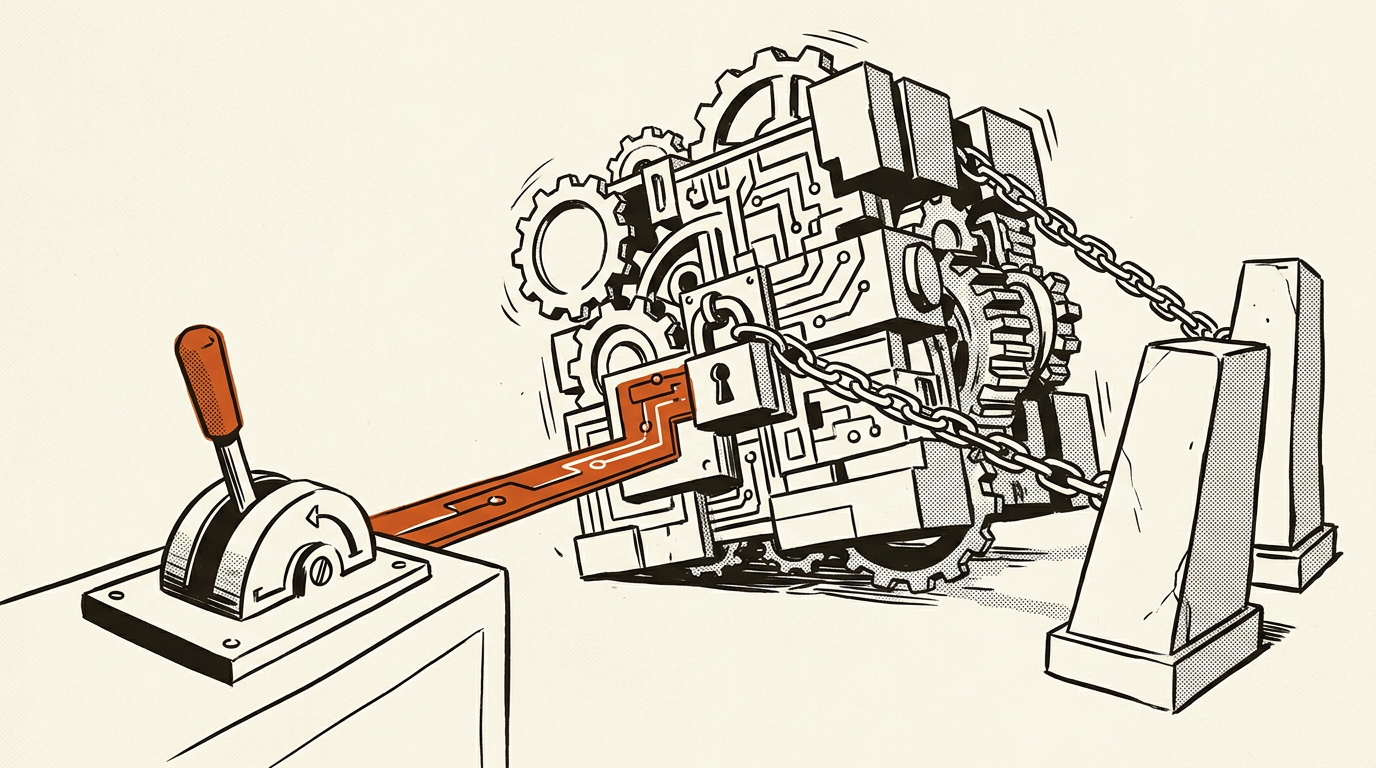
If you've seen the clip doing the rounds — Sky News Australia, bold caption, "Anthropic fears losing control of AI" — here's what's actually behind it, and why it's worth more than a doom-scroll.
The headline traces to a recent essay by Dario Amodei, the CEO of Anthropic (the lab behind Claude), titled Policy on the AI Exponential. Strip away the TV framing and it's a serious, specific regulatory proposal — and a striking one, because it's a frontier AI company asking governments for the power to switch off its own products.
What he's actually proposing
Amodei's pitch is modelled on aviation. Just as an aircraft can't fly until it's been independently tested and certified, he argues that frontier AI models above a certain size should face mandatory third-party testing before release — assessed across four specific risk categories:
- Cybersecurity — could the model supercharge attacks?
- Biological weapons — could it help build one?
- Loss of control of AI systems — the one the headlines seized on.
- Automated R&D — AI that accelerates the development of more powerful AI.
In his words: "Frontier AI models, like airplanes, should be required to go through technical testing and auditing."
And the part that makes labs uncomfortable: he wants the state to have teeth. "The government should have the power to block or deter deployment of the model if it is determined… to present unacceptable risks." Block — or reverse — a release that fails the tests. He's careful to scope that power tightly to those four risks, with guardrails against political favouritism. But the principle is blunt: a company that builds the thing is asking for an outside authority that can stop it shipping.
Why "loss of control" is the line that cut through
Three of those four categories are about misuse — a human pointing a powerful tool at something terrible. The third is different. "Loss of control" is about the model itself behaving in ways its makers didn't intend or can't rein in. Amodei has said plainly that "serious AI autonomy risks may not be far behind." That's the sentence that turns a policy white-paper into a Saturday-night news segment — and, fairly, the one most worth taking seriously.
The obvious tension — and we'll name it
The reasonable objection writes itself: Anthropic is one of the companies building the most capable AI on earth, while warning that it's dangerous. Critics call that having it both ways. Anthropic's answer is its long-stated "race to the top" argument — that it would rather be inside the frontier pushing for safety and binding rules than leave the field to labs that won't. You can find that convincing or self-serving; the tension is real either way, and worth holding in view rather than waving away.
It's also a pointed contrast for UK readers: this is the most aggressive call for mandatory AI rules from any frontier lab, at a moment when Britain has deliberately chosen a lighter-touch, no-dedicated-AI-bill path.
We've covered Anthropic's regulatory push before — its aviation-style ask alongside a $200M economic pledge, and its stand-off with the Pentagon over safety red lines. What's new here is the framing now reaching mainstream television: not "AI is exciting," but a builder of it asking, openly, for a brake pedal someone else can press.
Whether governments take him up on it is the real story to watch.
Ask Relay — he reads every question himself and replies personally by email.