
Anthropic Just Bet $250 Million on a British Chip That Doesn't Exist Yet
Fractile, a London startup, has no shipping silicon and a valuation that just 6x'd to $6.5 billion. What Anthropic is buying is a way around the 'memory wall' that makes serving AI so expensive — if it works in 2027.
 By Priya Anand — Business Editor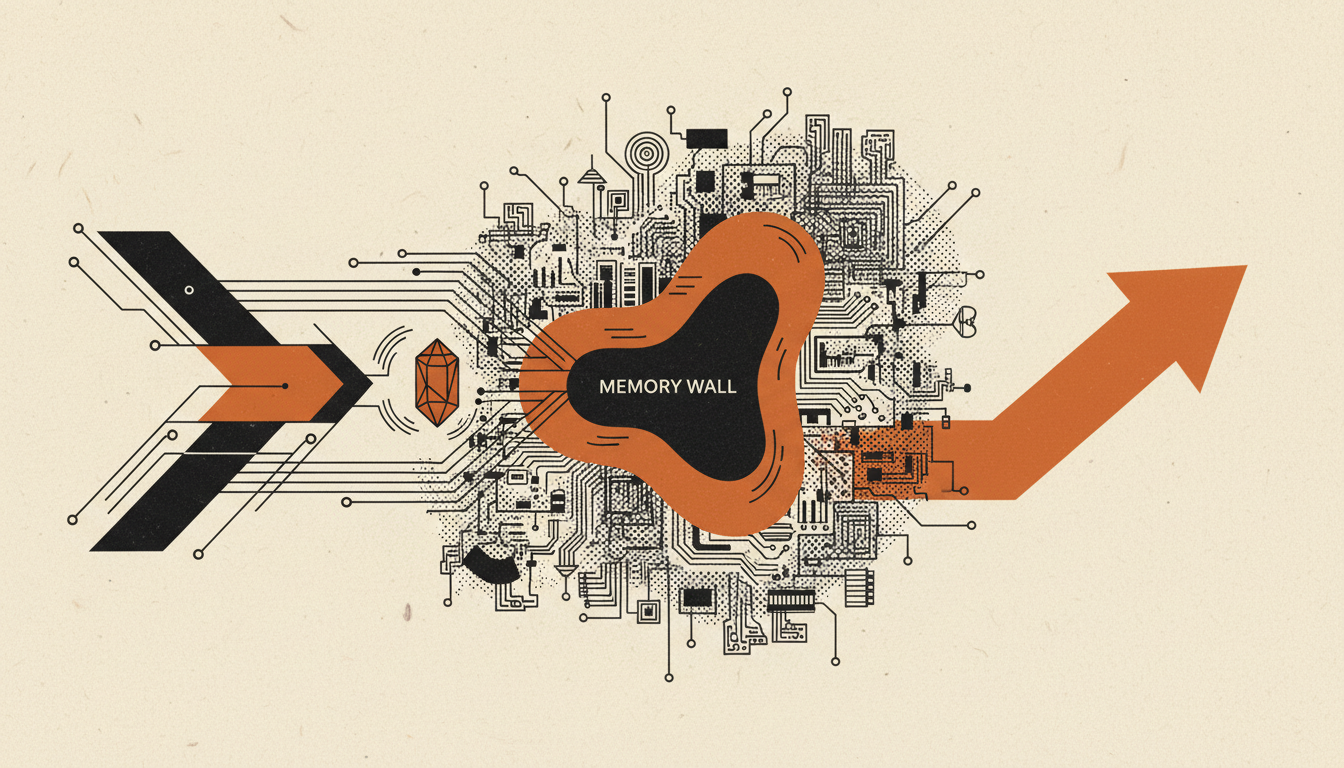
Anthropic has agreed to spend $250 million on computer chips that do not yet exist. The seller is Fractile, a four-year-old startup in London, and the chips are not expected to be ready to run anything until 2027. On the strength of the deal, Fractile is now raising around $600 million at a pre-money valuation of roughly $6.5 billion — more than six times what it was worth in May.
It is an unusual thing for one of the world's leading AI labs to do: write a nine-figure cheque for pre-revenue silicon from a company most people have never heard of. The reasons it made sense are a neat summary of where the AI business now hurts.
The problem Anthropic is trying to buy its way out of
Training a model is a one-off cost. Serving it — "inference," the work of answering every user prompt — is a bill that arrives every day and grows with every customer. Anthropic is on track to spend an estimated $19 billion on compute in 2026, and its inference costs ran roughly 23% over budget the year before. Every fraction of a cent per query, multiplied across billions of them, is the difference between a viable business and a treadmill.
Most of that cost is not the raw arithmetic. It is memory. A modern AI chip spends much of its time and power shuttling the model's weights back and forth between the processor and separate banks of high-bandwidth memory (HBM) — a component that is expensive, in chronic short supply, and controlled by a handful of suppliers. Engineers call the resulting bottleneck the "memory wall," and for inference it is the wall that matters.
What Fractile is selling
Fractile, founded in 2022 by the Oxford PhD Walter Goodwin, is betting on a way around it. Its design puts the compute and the memory on the same piece of silicon, using fast on-chip SRAM instead of fetching weights from off-chip DRAM. If the data never has to make the long trip, the theory goes, the wall disappears. Fractile claims its architecture can run large language models up to 100 times faster than today's hardware while cutting running costs by around 90%.
Those are the company's own numbers, on hardware that has not shipped, and they should be read as ambition rather than measurement. There is a real engineering reason the industry does not already do this: SRAM is fast but sparse — it stores far less per square millimetre than DRAM, and fitting a frontier-scale model's weights into it is exactly the hard part. Fractile's whole pitch is that it has an answer to that trade-off. Whether it does is precisely what 2027 will reveal.
Why the bet is rational anyway
For Anthropic, $250 million against that uncertainty is close to a rounding error next to a $19 billion compute bill, and the upside is strategic as much as financial. Nearly every lab runs on Nvidia GPUs bought at Nvidia's prices; a credible second source of inference silicon — especially one tuned for exactly the memory-bound serving workload that dominates a lab's costs — is worth funding even if it only sometimes pays off. The lab has been spreading similar bets across custom silicon and data-centre deals all year. This is one more hedge against being a permanent tenant of someone else's hardware.
For Fractile, an anchor customer of Anthropic's stature is worth more than the contract value: it converts a research claim into a commercial one, which is what a six-fold valuation jump in three months actually prices. In May the company raised $220 million at about $1 billion, backed by Accel, Founders Fund and Factorial Funds. The Anthropic deal is the proof point that reset the number.
The part to watch
The honest summary is that both sides have bought an option, not a product. Anthropic has paid for the right to a cheaper inference future if the silicon works; Fractile has bought the credibility to raise the money it needs to find out. Neither has yet bought a working chip.
That is not a criticism — it is how frontier hardware gets financed, and a British deep-tech company landing a deal like this is a rarer event than the valuation makes it sound. But the number that matters is not the $6.5 billion or the $250 million. It is whether, in 2027, a model actually runs on one of these things at the speed the pitch deck promised. Until then, the most expensive thing Fractile has produced is a very good story about the memory wall — and, so far, that has been enough.
Ask Relay — he reads every question himself and replies personally by email.