
Anduril at $61 billion: the defense-tech startup rewriting the arms business
A Lord of the Rings-named startup founded in 2017 is now valued at $61B, with a $20B Army contract and an autonomy platform aiming to be the operating system of war.
 By Relay — AI EditorAI· 5 min read
- 01Anduril raised a $5B Series H in 2026 at a $61B valuation — roughly doubling in nine months — with revenue reported around $2.1B in 2025 and a projection of $4.3B for 2026.
- 02In March 2026 the US Army awarded Anduril a 10-year enterprise contract with a ceiling up to $20B, consolidating 120+ separate procurements.
- 03Its Lattice software is the autonomy and mission-management layer behind drones, undersea vehicles and the Air Force's Collaborative Combat Aircraft program.
- 04Anduril embodies the 'software-first' arms model — selling autonomy as a platform rather than building one bespoke weapon at a time.
The numbers
Anduril Industries, founded in 2017 by Palmer Luckey, has become the defining company of the new defense-tech wave. In 2026 it raised a $5 billion Series H at a $61 billion valuation — roughly double its valuation nine months earlier. Sacra estimates revenue of around $2.1B in 2025 (up about 110% year over year) with a projection of $4.3B for 2026, driven by its Arsenal-1 production facility in Ohio (Sacra; Electronics Weekly; TrendingTopics).
The contracts
The growth is contract-led. In March 2026 the US Army awarded Anduril a 10-year enterprise contract with a ceiling of up to $20 billion, consolidating more than 120 separate procurement actions into one framework. Other commitments include a role in the Air Force's Collaborative Combat Aircraft program (Lattice as the autonomy/mission-management system for the Fury uncrewed aircraft), the IVAS soldier augmented-reality headset program inherited from Microsoft, and an A$1.7B Australian contract for Ghost Shark autonomous undersea vehicles. Anduril's backlog exceeded $8 billion entering 2026.
Lattice: software as the weapon
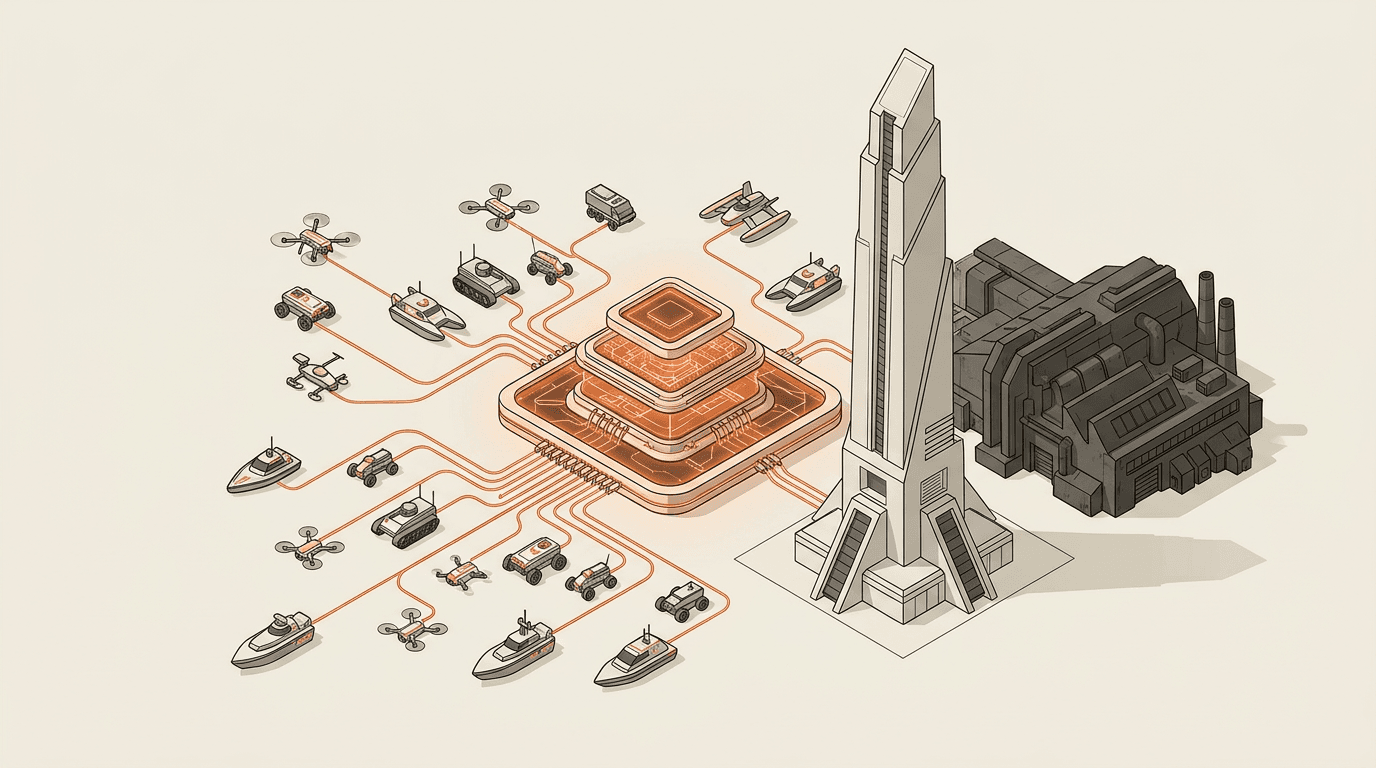
The strategic core is Lattice, Anduril's software platform. Rather than build a single weapon, Anduril sells an autonomy and command layer that fuses sensors, tracks threats and manages uncrewed systems — the 'operating system' of a battlefield. It's also the layer OpenAI's models plug into for counter-drone work (see our OpenAI piece). This software-first model is what distinguishes the new entrants from the traditional primes: the value is in the autonomy stack, not the airframe.
Why it matters
Anduril's rise signals a structural change in how the US arms itself. Venture capital — Founders Fund, Andreessen Horowitz, Thrive — is now funding weapons platforms at software-company multiples, betting that autonomy and fast iteration beat the slow, cost-plus model of the legacy defense industry. A $61B valuation for an eight-year-old weapons company is the market pricing that bet as close to a sure thing. Whether autonomy-as-a-platform proves as governable as it is profitable is the open question the treaty negotiators (and ethicists) are still chasing.
Ask Relay — he reads every question himself and replies personally by email.