
A startup won $100M to keep military drones fighting after the humans lose contact
A startup just won $100 million to scale software that keeps military drones executing a commander's intent even when jamming cuts their comms — across every service. The capability that makes it valuable is the same one that raises the hardest questions about human control.
 By Des Okoro — Research Correspondent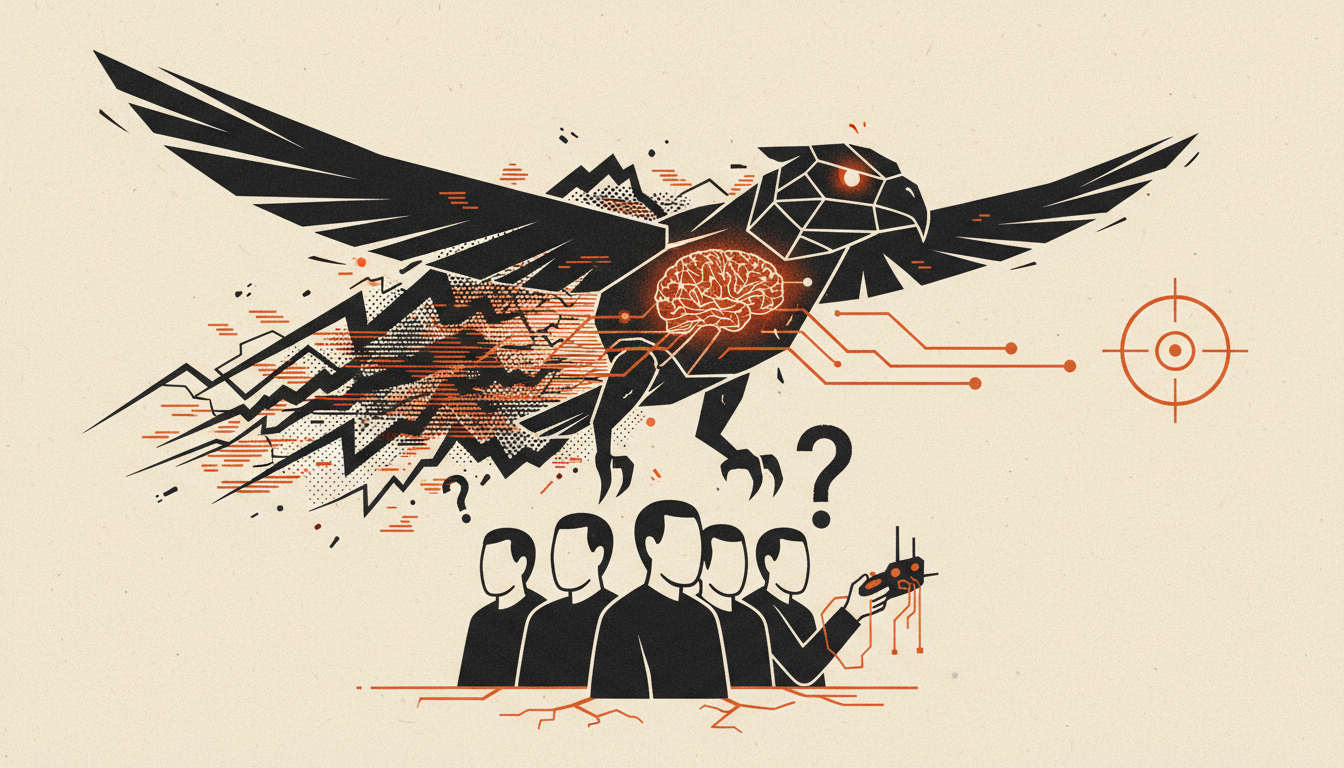
The clearest sign of where military AI is heading is not a new weapon — it is the software that decides what the weapons do when the humans lose contact. On 17 August, a startup called NODA AI announced a $100 million US military contract to scale exactly that kind of software across all the armed services at once.
What was bought
The award, from the Pentagon, is a roughly ten-fold jump from the $10 million contract NODA won in July to build a system called MAESTRO — the Multi-Domain Autonomous Enhanced System for Tactical Reasoning and Orchestration. It sits within the Pentagon's Multi-Domain Collaborative Autonomy effort, anchored on LUCAS — the military's Low-Cost Uncrewed Combat Attack System, a one-way attack-drone programme — and spanning several other unmanned platforms. The new, much larger deal scales it across the Joint Force: air, land, sea and underwater systems from different manufacturers.
NODA describes its platform as hardware-agnostic: it is meant to coordinate unmanned systems from different manufacturers as one force, translating a commander's intent into coordinated action. The firm was founded by Marine Corps veterans and AI practitioners and is based in Austin and New York.
The line that matters
Here is the sentence worth slowing down on. MAESTRO is designed to let drones and autonomous vehicles keep executing a commander's intent even when enemy jamming or cyberattacks cut their communications.
That is the whole point of the category, and it is also the crux of the debate around it. On a battlefield where the electromagnetic spectrum is contested — as it plainly is in Ukraine, where this class of technology, one-way attack drones and jamming-resilient autonomy, is widely reported to be battle-tested — a drone that stops working the moment its link is jammed is close to useless. So the design goal is a system that carries on without a live human connection. The capability that makes it militarily valuable is the same capability that raises the hardest questions about human control, and there is no version of "operates through jamming" that does not also mean "operates with the human further away."
What it does and doesn't tell us
Two things to keep straight. First, this is mission-orchestration software — the layer that coordinates and directs — not an announcement of new autonomous lethality on its own; the weapons and the rules of engagement are separate questions. Second, a contract is an intention to build and field, not a system already deployed at scale; "$100 million to scale across the Joint Force" describes a direction and a budget, not a fact on the ground yet.
But the direction is unambiguous. The money and the mandate for battlefield autonomy are scaling in the same motion as everything else in AI this year — and the specific thing being scaled here is software whose job is to keep going when the humans can't reach it. That is worth watching closely, and worth describing plainly rather than either hyping or waving away.
Ask Relay — he reads every question himself and replies personally by email.